Home / Abs / Dead Bug Exercise
Dead Bug Exercise: Form, Muscles Worked and Progressions
By Fitness ScienceUpdated 10 min read9 peer-reviewed studiesEditorial policy
- No equipment
- Beginner
- Deep core
On this page
The dead bug is a gentle, low-load way to start training your core, and it slots into our full no-equipment abs workout as a warm-up or a main exercise. Lying on your back gives you instant feedback: if your lower back lifts off the floor, your abs have lost control of the movement.
What the research shows
Only a handful of studies have measured the dead bug directly, and they are small.
It works the deepest ab muscle. In an ultrasound study of 44 healthy women, the dead bug thickened the transversus abdominis (the deep muscle that wraps around your waist like a belt) more than four other Pilates exercises, including the side plank and the hundred (Tsartsapakis and colleagues, 2023).
It works the front abs evenly. In a study of 12 healthy adults, the dead bug used the rectus abdominis (your six-pack muscle) and the obliques about equally. Activity rose with each harder version of the exercise (Souza and colleagues, 2001).
The bodyweight version is low intensity. In that same study, no muscle went above 41% of its maximum effort, and the authors suggested this is probably not enough to build strength in healthy people (Souza and colleagues, 2001). Treat the bodyweight dead bug as control and endurance work, and make it harder over time.
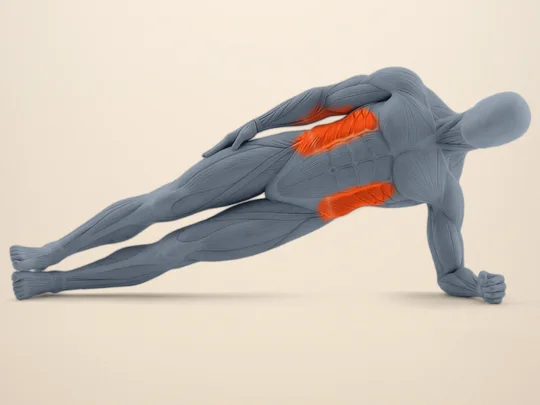
Other exercises hit other muscles harder. A 2024 ultrasound study of 44 young adults compared seven core exercises, including the dead bug. The bird dog and side plank produced the biggest overall increase in deep ab and back muscle thickness (Tsartsapakis and colleagues, 2024), so pair dead bugs with side planks and our oblique exercises at home.
No core exercise burns fat off your stomach. In a 6-week study, 24 adults did seven ab exercises five days a week. Their ab endurance improved, but their belly fat did not change (Vispute and colleagues, 2011). Visible abs depend on your overall body fat.
Bracing or hollowing?
Hollowing means gently drawing your belly button in. Bracing means tightening your whole waist, as if someone were about to poke your stomach.
| Cue | What studies found | When to use it |
|---|---|---|
| Hollowing | Thickened the deep ab and back muscles more than bracing (Tsartsapakis and colleagues, 2024) | Learning the movement |
| Bracing | Made the spine more stable (Grenier and McGill, 2007; Vera-Garcia and colleagues, 2007) | Harder and weighted versions |
Neither bracing study tested the dead bug, so treat them as a general guide. In a model based on 8 men, bracing improved spine stability by 32%, while the transversus abdominis added only 0.14% (Grenier and McGill, 2007). In 11 men, hollowing did not reduce spine movement after a sudden push, while bracing did, at the cost of more load on the spine (Vera-Garcia and colleagues, 2007).
Learn the dead bug with a gentle draw-in, then switch to a light 360-degree brace as the reps get harder. You should still be able to breathe.
How to do the dead bug
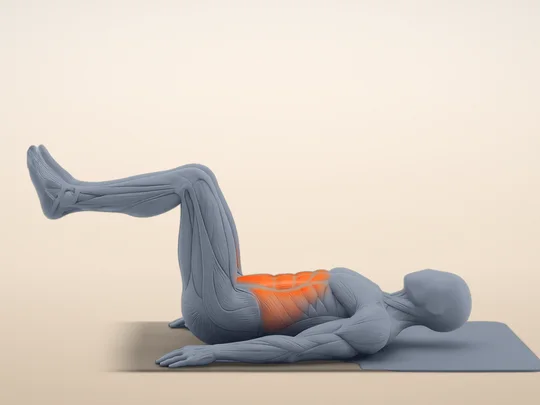
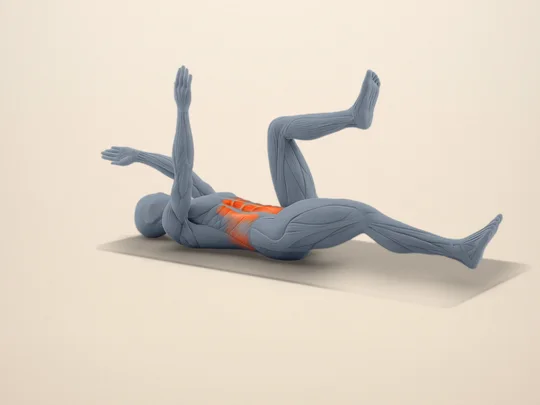
Dead bug
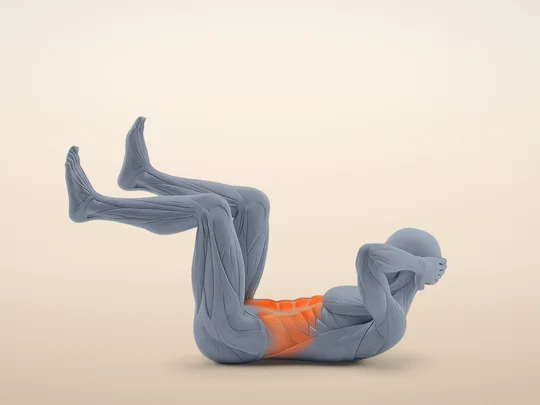
Trains: transversus abdominis, rectus abdominis and obliques, with the hip flexors working as your leg moves.
How to do it: Lie on your back with your arms pointing straight up over your shoulders. Lift your legs so your hips and knees are bent at 90 degrees and your shins are parallel to the floor. Breathe out to drop your lower ribs, and let your lower back rest lightly on the mat. Over about 3 seconds, lower your left arm behind your head and straighten your right leg until your heel hovers 5 to 10 cm (2 to 4 in) above the floor. Stop sooner if your lower back starts to lift. Pause for a second, breathe in as you return to the start, then switch sides.
Why it works: Reaching out with the opposite arm and leg makes your body a longer lever, which pulls your lower back toward an arch. Your abs have to hold your spine and pelvis still against that pull.
Common mistake: arching your lower back or flaring your ribs up to get the heel closer to the floor. Stop wherever your back stays still, even if your heel ends up well above the floor.
Easier or harder: keep the knee bent and tap your heel to the floor to make it easier. Slow the lowering to 5 seconds or hold light weights to make it harder.
Regressions and progressions
Move up a level when you can do 3 sets of 8 slow reps per side without your lower back lifting or your ribs flaring.
| Level | Variation | Sets and reps | Tempo |
|---|---|---|---|
| 1 | Heel taps (knees bent, arms up) | 2 to 3 sets of 8 to 10 per side | 3 seconds down |
| 2 | Arms only, legs held still | 3 sets of 8 per side | 3 seconds down |
| 3 | Classic dead bug | 3 sets of 8 to 10 per side | 3 seconds down, 1 second pause |
| 4 | Slow dead bug | 3 sets of 6 to 8 per side | 5 seconds down, 2 second pause |
| 5 | Weighted dead bug | 3 sets of 6 to 8 per side | 3 seconds down, 1 second pause |
Speed changes how your abs work. In a leg-lowering test similar to the dead bug, 16 healthy men lowered a leg in 5, 3 or 1 seconds while keeping a pressure cuff under their lower back steady. Fast reps made ab activity jump in the middle of the movement, slow reps built it up gradually, and by the end the levels were similar (Yoshikawa and colleagues, 2025). Slow reps are easier to control while you learn.
Weighted dead bug
Trains: the same ab muscles under more load, plus shoulder control.
How to do it: Hold a light dumbbell, about 2 to 5 kg (5 to 10 lb), in each hand above your shoulders and set up as for the classic version. Brace, breathe out, lower one arm and the opposite leg, then return and switch sides.
Why it works: The bodyweight version kept every muscle under 41% of maximum effort (Souza and colleagues, 2001), which leaves room for load. No study has measured the weighted version, but weight at the end of a long arm adds to the pull your abs resist.
Common mistake: going too heavy, so the weights drag your ribs up or your shoulders shrug toward your ears.
Easier or harder: hold one weight with both hands to make it easier, or slow the tempo to make it harder.
Fixing an arching lower back
If your lower back lifts or aches, your leg is going further than your abs can control and your pelvis tips forward. Try these fixes:
- Slide a thin folded towel under your lower back and keep light, steady pressure on it. If the pressure disappears, shorten the reach.
- Breathe out slowly as you lower, which helps keep your ribs down.
- Stop the leg higher above the floor, or go back to heel taps for a week or two.
For long-term low back pain, the dead bug counts as motor control exercise. A Cochrane review of 29 trials with 2,431 people found this kind of exercise eased chronic low back pain more than minimal treatment, about as well as other exercise, with minor or no side effects (Saragiotto and colleagues, 2016). It did not test the dead bug alone, so ask a physio what suits your back.
Why your hip clicks
Some people feel a painless click at the front of the hip as the leg lowers. About 5 to 10% of people have a snapping hip with no pain. When the snap is felt on the inner front of the hip, it is often put down to the iliopsoas tendon (your main hip flexor) flicking over a bony point at the top of the thigh bone (Sugrañes and colleagues, 2023).
If it does not hurt, try these changes:
- Stop the leg higher so the hip does not straighten fully.
- Keep a soft bend in the moving knee.
- Lower the leg more slowly, over 4 to 5 seconds, or go back to heel taps for a couple of weeks.
If the click comes with sharp groin pain, a catching feeling or soreness that lingers, stop and get it checked.
How often to do dead bugs
Dead bugs are low load, so 2 to 4 days a week works for most people. As a warm-up, do 2 sets of 6 to 8 slow reps per side. In a core session, do 3 sets of 8 to 10 per side with 45 to 60 seconds of rest.
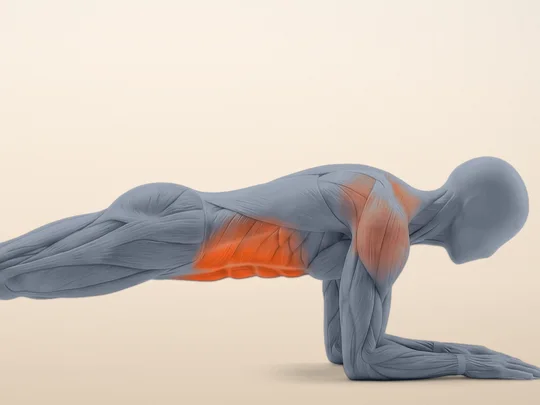
Balance them with side planks, which did better than the dead bug in the 2024 ultrasound study (Tsartsapakis and colleagues, 2024). Our guide to plank benefits and how long to hold shows how to fit planks into the same week. For the lower part of your abs, add moves from our lower abs workout at home.
Key takeaways
- The dead bug trains your abs to hold your lower back still while your limbs move.
- Small studies show it works the deep transversus abdominis and the front abs at low intensity.
- Learn it with a gentle draw-in, then use a light full brace for harder and weighted versions.
- If your back arches, shorten the reach. If your hip clicks without pain, keep the leg higher and the knee soft.
- Ab exercises build endurance and control. They do not remove belly fat.
Frequently asked questions
Why does my lower back lift off the floor during dead bugs?
Your leg is reaching further than your abs can control, so your pelvis tips forward and your back arches. Shorten the reach, breathe out slowly as you lower, and keep light pressure on a folded towel under your lower back. If it still lifts, go back to bent-knee heel taps for a week or two.
Why does my hip click during dead bugs?
A painless click at the front of the hip is often put down to the hip flexor tendon flicking over bone. About 5 to 10% of people have a painless snapping hip (Sugrañes and colleagues, 2023). Keep the leg higher, bend the knee slightly and lower more slowly. See a doctor or physio if it hurts.
Should I press my lower back flat into the floor?
You do not need to force it flat. Let your lower back rest on the mat with light, steady contact, and keep that contact the same from the start of each rep to the end. A thin folded towel under your back helps you feel any change. Avoid tucking your tailbone hard or holding your breath.
How many dead bugs should I do?
Start with 2 to 3 sets of 6 to 10 slow reps per side, 2 to 4 days a week, with 45 to 60 seconds of rest between sets. Easy bodyweight sets are fine as a daily warm-up for most healthy people. Move to a harder version once 3 sets of 8 slow reps per side feel controlled.
Is the dead bug better than planks or crunches?
They train different things. The dead bug teaches you to keep your spine still while your limbs move. In one ultrasound study, side planks and bird dogs produced a bigger overall increase in deep core muscle thickness than the dead bug (Tsartsapakis and colleagues, 2024). Combine it with planks and side planks.
Safety note
This guide is general fitness information, not medical advice. The dead bug is a low-load exercise, but stop if you feel sharp lower back pain, pain spreading into your buttock or leg, a painful catch in your hip, or dizziness while lying flat. If you are pregnant or postpartum, have had abdominal surgery, or have back pain or a back injury, check with a doctor or physiotherapist before doing exercises on your back.
Sources
- Tsartsapakis I, Gerou M, Zafeiroudi A, Kellis E. Transversus abdominis ultrasound thickness during popular trunk-Pilates exercises in young and middle-aged women. Journal of Functional Morphology and Kinesiology. 2023;8(3):110. doi:10.3390/jfmk8030110
- Tsartsapakis I, Bagioka I, Fountoukidou F, Kellis E. A comparison between core stability exercises and muscle thickness using two different activation maneuvers. Journal of Functional Morphology and Kinesiology. 2024;9(2):70. doi:10.3390/jfmk9020070
- Souza GM, Baker LL, Powers CM. Electromyographic activity of selected trunk muscles during dynamic spine stabilization exercises. Archives of Physical Medicine and Rehabilitation. 2001;82(11):1551-1557. doi:10.1053/apmr.2001.26082
- Vispute SS, Smith JD, LeCheminant JD, Hurley KS. The effect of abdominal exercise on abdominal fat. Journal of Strength and Conditioning Research. 2011;25(9):2559-2564. doi:10.1519/JSC.0b013e3181fb4a46
- Grenier SG, McGill SM. Quantification of lumbar stability by using 2 different abdominal activation strategies. Archives of Physical Medicine and Rehabilitation. 2007;88(1):54-62. doi:10.1016/j.apmr.2006.10.014
- Vera-Garcia FJ, Elvira JL, Brown SH, McGill SM. Effects of abdominal stabilization maneuvers on the control of spine motion and stability against sudden trunk perturbations. Journal of Electromyography and Kinesiology. 2007;17(5):556-567. doi:10.1016/j.jelekin.2006.07.004
- Yoshikawa K, Hashimoto M, Murata R, et al. Effects of different lower limb movement velocities on trunk muscle activity and dynamic stability in the Sahrmann core stability test. PLoS One. 2025;20(9):e0333004. doi:10.1371/journal.pone.0333004
- Saragiotto BT, Maher CG, Yamato TP, et al. Motor control exercise for chronic non-specific low-back pain. Cochrane Database of Systematic Reviews. 2016;(1):CD012004. doi:10.1002/14651858.CD012004
- Sugrañes J, Jackson GR, Warrier AA, Allahabadi S, Chahla J. Snapping hip syndrome: pathoanatomy, diagnosis, nonoperative therapy, and current concepts in operative management. JBJS Reviews. 2023;11(6). doi:10.2106/JBJS.RVW.23.00005
Change log: 28 Nov 2026, first published. Every study checked against its abstract and DOI.
Related guides