
Home / Abs
Abs Workout at Home With No Equipment: 9 Moves and a 4-Week Plan
By Fitness ScienceUpdated 9 min read8 peer-reviewed studiesEditorial policy
- No equipment
- 10 minutes
- 9 exercises
On this page
This guide covers the 9 moves in our follow-along abs workout, a 10-minute format and a 4-week plan. To go deeper, see our guides to the lower abs workout at home and oblique exercises at home.
Why a mix of moves works
The rectus abdominis (the "six-pack" muscle) curls your spine and stops your lower back arching. The obliques twist your trunk and stop it bending sideways. A review of core exercise studies found the internal obliques worked hardest in stability exercises (Oliva-Lozano and Muyor, 2020). In a lab study of 18 adults, crunches and face-down planks worked the rectus abdominis harder than side planks, while the side plank on your toes worked the external obliques harder than a crunch or a plank on your knees (Escamilla and colleagues, 2016).
You do not need special "lower abs" moves. With posture controlled, a study of 11 people found no difference in activity between the upper and lower parts of the rectus abdominis (Lehman and McGill, 2001).
What ab exercises can and cannot do
Ab training builds strength and endurance, but it does not burn the fat on top of your abs. In a 6-week trial, 24 adults either did nothing or did 7 ab exercises, 2 sets of 10 reps, 5 days a week, with their diet unchanged. The exercise group could do more curl-ups at the end (47 compared with 32), but there was no significant change in body weight, body fat percentage, belly fat, waist size or skinfolds (Vispute and colleagues, 2011).
Whether your abs show depends on your body fat, so look at your overall diet and activity if you want them visible.
The 9-move abs workout at home
You need a mat and a space about 2 m by 1 m (6.5 ft by 3.3 ft). Control work comes first, then curls and twists, then holds, and the two hardest moves last.
1. Dead bug
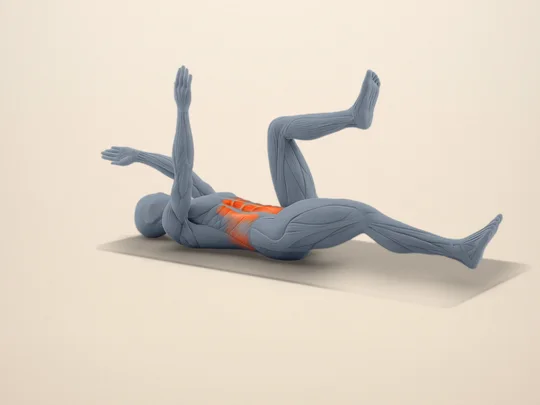
Trains: the deep core, the obliques and the rectus abdominis.
How to do it: Lie on your back, arms up, hips and knees bent to 90 degrees, lower back pressed gently down. Breathe out and lower one arm behind you and the opposite leg toward the floor, stopping 5 to 10 cm (2 to 4 in) above it. Return and switch sides.
Why it works: Your trunk stays still while your limbs move, the kind of stability work that loaded the internal obliques most (Oliva-Lozano and Muyor, 2020). See our dead bug exercise guide.
Common mistake: letting your lower back lift as the leg goes down.
Easier or harder: keep your knees bent and tap your heels down to make it easier. Pause for 2 seconds at the bottom to make it harder.
2. Crunches
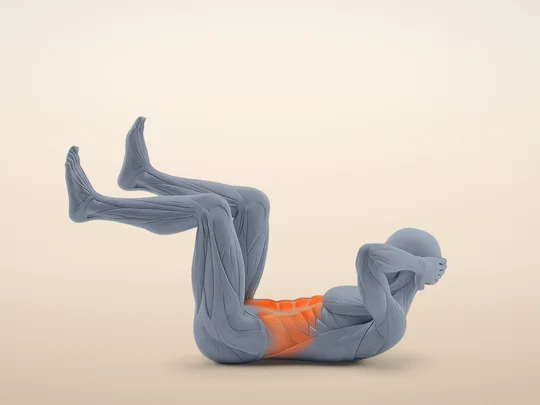
Trains: the rectus abdominis.
How to do it: Lie on your back, knees bent, feet flat, fingertips by your ears. Breathe out and curl your ribs toward your hips until your shoulder blades lift 5 to 8 cm (2 to 3 in). Pause for 1 second, then lower over 2 seconds.
Why it works: The crunch worked the rectus abdominis hard, and the bent-knee sit-up used the hip flexor at the front of the thigh significantly more (Escamilla and colleagues, 2016).
Common mistake: pulling on your head. Keep a fist-sized gap under your chin.
Easier or harder: reach your arms toward your knees to make it easier. Hold your arms overhead to make it harder.
3. Reverse crunch
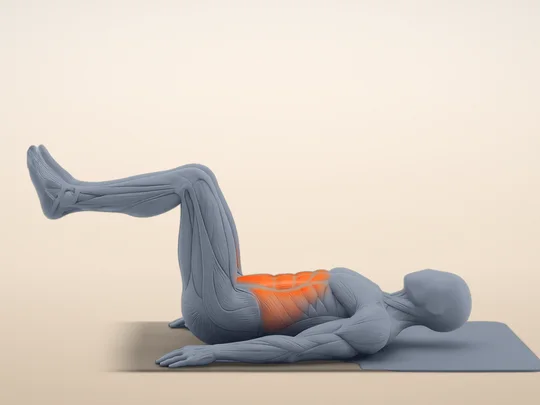
Trains: the rectus abdominis and the obliques.
How to do it: Lie on your back, arms by your sides, hips and knees at 90 degrees. Breathe out and curl your tailbone 5 to 8 cm (2 to 3 in) off the floor. Lower over 2 to 3 seconds.
Why it works: In a study of 21 adults, a reverse crunch on a 30 degree incline was among the exercises with the highest rectus abdominis and internal oblique activity. It also had high hip flexor activity, which the authors said may be a problem for some people with low back pain (Escamilla and colleagues, 2006).
Common mistake: swinging your legs to get your hips up.
Easier or harder: tuck your knees tighter to make it easier. Straighten your legs a little to make it harder.
4. Bicycle crunches
Trains: the obliques and the rectus abdominis.
How to do it: Lie on your back, fingertips by your ears, shoulders lifted. Turn your right shoulder toward your left knee while you straighten your right leg 15 to 20 cm (6 to 8 in) above the floor. Switch sides about every 2 seconds.
Why it works: Turning your ribcage during a crunch makes your obliques work along with the six-pack muscle.
Common mistake: pedalling fast and only moving your elbows. Turn from your ribs.
Easier or harder: keep the straight leg higher to make it easier. Hold each twist for 1 second to make it harder.
5. Russian twist
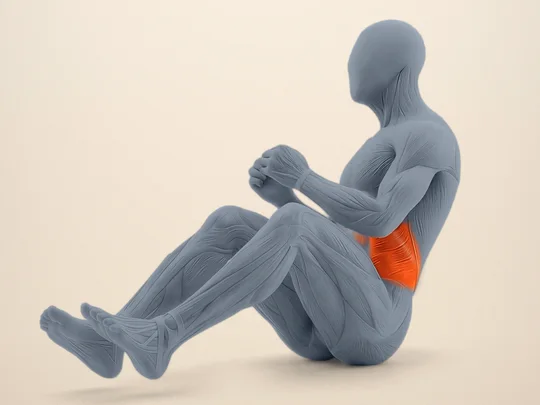
Trains: the obliques, with the rectus abdominis holding you in place.
How to do it: Sit with your knees bent and heels down. Lean back to about 45 degrees with a long back. Keep your hips still and turn your ribs and hands to one side, then the other.
Why it works: The lean keeps your abs working while the turn trains your obliques.
Common mistake: rounding your back and swinging only your arms.
Easier or harder: lean back less to make it easier. Lift your heels 5 to 10 cm (2 to 4 in) to make it harder.
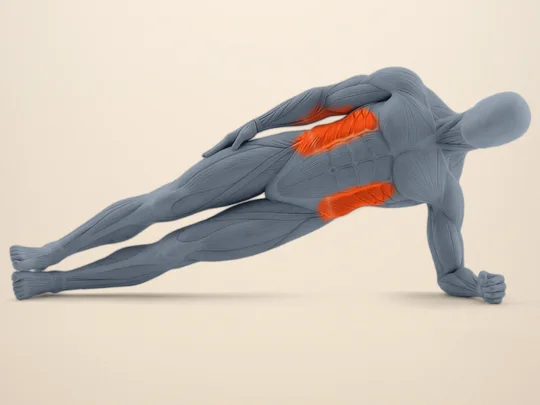
6. Elbow side plank (left and right)
Trains: the obliques, lower back and side glutes.
How to do it: With your elbow under your shoulder and feet stacked, lift your hips into a straight line from ear to ankle. Switch sides halfway through.
Why it works: In a study of 30 people, the side plank was one of the few bodyweight exercises to pass 45% of maximum effort in the external obliques and gluteus medius, a level suited to building strength (Ekstrom and colleagues, 2007).
Common mistake: letting your bottom hip sag.
Easier or harder: rest on your bent knees to make it easier. Lift your top leg 15 to 20 cm (6 to 8 in) to make it harder.
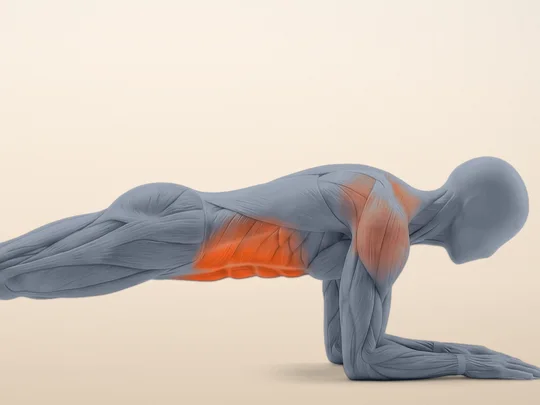
7. Front plank
Trains: the rectus abdominis, the obliques and the deep core.
How to do it: Rest on your forearms, elbows under shoulders, legs straight. Tuck your tailbone under slightly, squeeze your glutes and draw your shoulder blades slightly together. Hold a straight line from head to heels and keep breathing.
Why it works: A plain plank stayed below 45% of maximum effort, which suits endurance and stability training (Ekstrom and colleagues, 2007). Tucking the pelvis under with the shoulder blades drawn together gave the highest muscle activity of four plank positions tested (Cortell-Tormo and colleagues, 2017). See plank benefits and how long to hold.
Common mistake: letting your hips sag as you tire.
Easier or harder: drop to your knees to make it easier. Move your elbows 5 to 10 cm (2 to 4 in) further forward to make it harder.
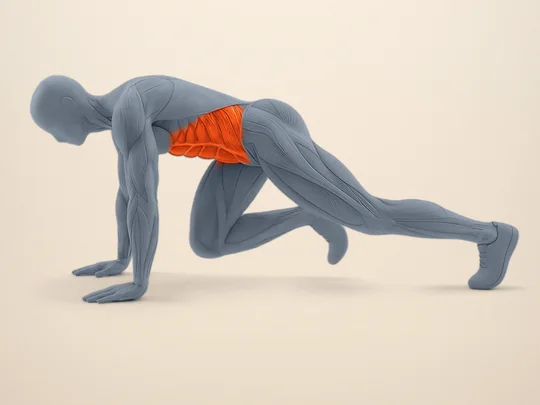
8. Mountain climber
Trains: the rectus abdominis, obliques, shoulders and hip flexors.
How to do it: From a high plank, drive one knee toward your chest, put it back and switch, keeping your hips level.
Why it works: Each time a foot leaves the floor, your trunk has to stop your hips sagging or twisting.
Common mistake: going so fast that your hips pike up or bounce.
Easier or harder: put your hands on a sofa or step 30 to 45 cm (12 to 18 in) high to make it easier. Move faster while keeping your hips still to make it harder.
9. V-up
Trains: the rectus abdominis, the obliques and the hip flexors.
How to do it: Lie flat, legs straight, arms overhead. Breathe out and lift your arms and legs together, reaching for your shins as you balance on your sit bones. Lower over 2 to 3 seconds.
Why it works: Long levers at both ends make this the hardest curl in the workout, so it comes last.
Common mistake: dropping back down and arching your lower back.
Easier or harder: bend your knees into a tuck-up to make it easier. Keep your heels just above the floor between reps to make it harder.
The 10-minute format
Our follow-along workout runs the 9 moves in order: 45 seconds of work, then 25 seconds of rest before the next move. That takes about 10 minutes. On the side plank, switch sides halfway through the 45 seconds.
How often to train abs
Train on 3 non-consecutive days a week. A review of 15 studies on muscle growth in general found that more weekly sets led to more growth (Schoenfeld, Ogborn and Krieger, 2017).
A simple 4-week plan
| Week | Rounds | Work and rest | Focus |
|---|---|---|---|
| 1 | 1 | 30 seconds on, 30 seconds rest | Easier versions, learn the form |
| 2 | 1 | 45 seconds on, 25 seconds rest | Full 10-minute format |
| 3 | 2 | 45 on, 25 rest, 2 minutes between rounds | Lower over 2 to 3 seconds |
| 4 | 2 | 45 on, 25 rest, 2 minutes between rounds | Harder versions where form holds |
After week 4, use harder versions and slower lowering before adding a third round.
Key takeaways
- Train curls, twists and holds. The 9 moves here cover all three.
- The rectus abdominis works as one muscle, so you do not need a separate lower abs routine (Lehman and McGill, 2001).
- Ab exercises build strength and endurance, but 6 weeks of ab training did not reduce belly fat (Vispute and colleagues, 2011).
- Use 45 seconds on and 25 off, 3 days a week, and progress over 4 weeks.
Frequently asked questions
Do ab workouts get rid of belly fat?
Not on their own. In a 6-week trial, people who did ab exercises 5 days a week could do more curl-ups than a control group at the end (47 compared with 32), but they lost no significant belly fat, waist size or body fat (Vispute and colleagues, 2011). Fat loss depends on your overall diet and activity.
Can I do an abs workout every day?
You can, but 3 non-consecutive days a week is a better starting point for a hard session like this one. A rest day between sessions lets you put full effort into each one. If you want to move on other days, walking or light stretching works well and will not take away from your next session.
Are planks better than crunches?
They do different jobs. In one lab study, the crunch worked the rectus abdominis harder than side planks, while the side plank on your toes worked the external obliques harder than the crunch did (Escamilla and colleagues, 2016). Doing both, plus some twisting moves, trains your whole core and keeps the workout more balanced.
How long should I hold a plank?
Hold it only as long as you can keep a straight line from head to heels. Start with 20 to 30 seconds. Once that feels easy, make the plank harder instead of simply holding it longer. Tucking your pelvis under and drawing your shoulder blades together raised core muscle activity the most in one study (Cortell-Tormo and colleagues, 2017).
Safety note
This guide is general fitness information, not medical advice. Stop any move that causes sharp pain, neck pain, numbness or dizziness, and switch to an easier version. If you have an injury, back pain, or a neck or pelvic floor problem, or you are pregnant or postpartum, check with a doctor or physiotherapist before you start.
Sources
- Vispute SS, Smith JD, LeCheminant JD, Hurley KS. The effect of abdominal exercise on abdominal fat. Journal of Strength and Conditioning Research. 2011;25(9):2559-2564. doi:10.1519/JSC.0b013e3181fb4a46
- Oliva-Lozano JM, Muyor JM. Core muscle activity during physical fitness exercises: a systematic review. International Journal of Environmental Research and Public Health. 2020;17(12):4306. doi:10.3390/ijerph17124306
- Escamilla RF, Lewis C, Pecson A, Imamura R, Andrews JR. Muscle activation among supine, prone, and side position exercises with and without a Swiss ball. Sports Health. 2016;8(4):372-379. doi:10.1177/1941738116653931
- Escamilla RF, Babb E, DeWitt R, et al. Electromyographic analysis of traditional and nontraditional abdominal exercises: implications for rehabilitation and training. Physical Therapy. 2006;86(5):656-671. doi:10.1093/ptj/86.5.656
- Cortell-Tormo JM, García-Jaén M, Chulvi-Medrano I, et al. Influence of scapular position on the core musculature activation in the prone plank exercise. Journal of Strength and Conditioning Research. 2017;31(8):2255-2262. doi:10.1519/JSC.0000000000001689
- Ekstrom RA, Donatelli RA, Carp KC. Electromyographic analysis of core trunk, hip, and thigh muscles during 9 rehabilitation exercises. Journal of Orthopaedic & Sports Physical Therapy. 2007;37(12):754-762. doi:10.2519/jospt.2007.2471
- Lehman GJ, McGill SM. Quantification of the differences in electromyographic activity magnitude between the upper and lower portions of the rectus abdominis muscle during selected trunk exercises. Physical Therapy. 2001;81(5):1096-1101. doi:10.1093/ptj/81.5.1096
- Schoenfeld BJ, Ogborn D, Krieger JW. Dose-response relationship between weekly resistance training volume and increases in muscle mass: a systematic review and meta-analysis. Journal of Sports Sciences. 2017;35(11):1073-1082. doi:10.1080/02640414.2016.1210197
Change log: 28 Nov 2026, first published. Every study checked against its abstract and DOI.
More abs guides