Home / Abs / Plank Benefits and How Long to Hold a Plank
Plank Benefits and How Long to Hold a Plank
By Fitness ScienceUpdated 9 min read9 peer-reviewed studiesEditorial policy
- No equipment
- All levels
- Core stability
On this page
The plank is a simple core exercise you can do anywhere, yet many people chase 3 and 5 minute holds when a harder 30 second plank would work their abs more. This guide covers what planks train, what the research says about hold times, and how to progress. Slot the holds into our full no-equipment abs workout to train your whole midsection.
What planks train and what they do for you
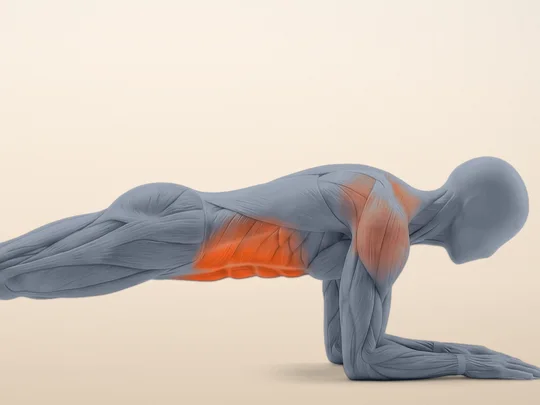
A forearm plank asks your trunk to stay still while gravity tries to make your lower back sag. Your abs, obliques and the deep muscles around your spine hold you in place, while your glutes, thighs and shoulders keep the rest of the body in line.
It works the deeper core muscles well. A review of 67 studies on core muscle activity found that core stability exercises like the plank produced the highest internal oblique activity of any exercise group. Free-weight lifts such as squats and deadlifts produced more rectus abdominis and lower back activity (Oliva-Lozano and Muyor, 2020).
It can help some people with back pain. A meta-analysis of 5 trials with 414 people with chronic low back pain found that core stability exercise reduced pain and disability more than general exercise in the short term. At 6 and 12 months, pain was no different between the two (Wang and colleagues, 2012). So core work helps, but it is not better than other exercise in the long run.
Side planks fill a gap. In a study of 75 young adults, men held a side bridge for 65% of their back extensor time and women for only 39% (McGill, Childs and Liebenson, 1999). That gap is a good reason to add side planks.
Isometric training may lower blood pressure. A network meta-analysis of 270 trials found that isometric exercise training cut resting blood pressure by 8.24 mm Hg systolic and 4.00 mm Hg diastolic, the largest drop of any exercise type (Edwards and colleagues, 2023). Wall squats did best, and planks were not studied on their own, so treat this as a possible bonus.
Planks will not burn belly fat. In a 6-week trial, 24 sedentary adults did abdominal exercises 5 days a week while keeping their diet the same. Their abdominal endurance improved, but body fat, belly fat and waist size did not change (Vispute and colleagues, 2011). Whether your abs show depends on your overall body fat.
How long should you hold a plank?
The best data on normal plank times comes from a study of 471 college students who held a forearm plank until they could not continue or their form broke. Men averaged 124 seconds and women 83 seconds. The medians were 110 seconds for men and 72 seconds for women (Strand and colleagues, 2014). These are fit young adults, and the authors said the norms need more testing before they apply to other groups. If you are older, heavier or new to exercise, expect lower times and do not worry about it.
No study has set an ideal hold time for building core strength. The practical rule is to end each set while your form is still clean: hips level, back flat, breathing steady. Several shorter holds of good quality give you more useful work than one long hold where the last minute is spent sagging.
| Your clean max hold | What to do | When to move on |
|---|---|---|
| Under 30 seconds | 3 to 4 sets of 15 to 25 seconds, hands on a bench if needed | When 3 sets of 25 seconds feel steady |
| 30 to 60 seconds | 3 sets of 30 to 45 seconds, adding 5 seconds a week | When 3 sets of 60 seconds feel steady |
| Over 60 seconds | 3 sets of 20 to 40 seconds of a harder variation | Make the variation harder again |
Why very long planks stop paying off
A floor plank is only moderately hard for your abs. In one study, 20 students held 8 plank variations for 5 seconds each while sensors measured muscle activity. The floor front plank used about 32% of the upper rectus abdominis's maximum effort. A stable roll-out plank reached 100%, and a front plank in suspension straps reached 131% (Calatayud and colleagues, 2017, as tabulated by Oliva-Lozano and Muyor, 2020).
Long holds also tend to end for reasons other than your abs. In the college study, about a third of people stopped because of their legs and another third because of their arms. Only about 21% stopped because their abs gave out (Strand and colleagues, 2014).
Longer holds also tire you out more. In a small study of 15 trained adults, a 3-minute plank lowered peak force afterward compared with 1 or 2-minute planks, and effort ratings went up with every extra minute (Aleais and colleagues, 2022). That was a single session, so it says nothing about long-term results.
How often should you do planks?
In the college study, people who were physically active more than 3 times a week held planks longer than people who rarely exercised, and those active more than 5 times a week did best (Strand and colleagues, 2014). That was general activity, not plank training. Plank 3 to 4 days a week, with 2 to 4 sets each time, and include a side plank.
How to do a plank and make it harder
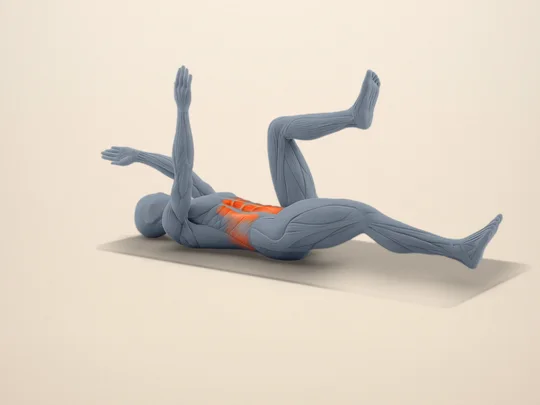
If your lower back aches in a plank, build control first with the dead bug exercise, which trains the same bracing lying on your back.
Forearm plank
Trains: rectus abdominis, obliques, transversus abdominis, glutes, thighs and shoulders.
How to do it: Place your elbows under your shoulders with your forearms parallel and your feet about hip width apart. Brace your stomach as if someone is about to poke it, squeeze your glutes and thighs, and keep a straight line from your ears to your ankles. Breathe steadily for 20 to 60 seconds.
Why it works: Your trunk has to resist your lower back sagging toward the floor, which builds endurance in the muscles that keep your spine steady.
Common mistake: letting your hips sag or hike up, or holding your breath. Stop the set as soon as your hips start to drop.
Easier or harder: put your forearms on a bench or sofa 30 to 60 cm (12 to 24 in) high, or drop to your knees, to make it easier. Once 3 sets of 60 seconds feel steady, move to the long-lever version below.
Long-lever posterior-tilt plank
Trains: upper rectus abdominis, lower abdominals and external obliques.
How to do it: Set up as for a forearm plank, then place your elbows a few centimetres in front of your shoulders. Squeeze your glutes hard so your tailbone tucks under and your lower back flattens. Pull your elbows toward your toes without moving them. Hold for 15 to 30 seconds.
Why it works: In a study of 19 people, this version produced more upper rectus abdominis, lower abdominal and external oblique activity than a standard plank. Placing the elbows further forward made the biggest difference, and the pelvic tilt added extra oblique work (Schoenfeld and colleagues, 2014).
Common mistake: reaching so far forward that your lower back arches. Start with your elbows 5 cm (2 in) ahead of your shoulders and move them forward only while your back stays flat.
Easier or harder: bring your elbows back under your shoulders to make it easier. Move them further forward, or progress to a roll-out plank, to make it harder. Our lower abs workout at home has more moves that build on this tilt.
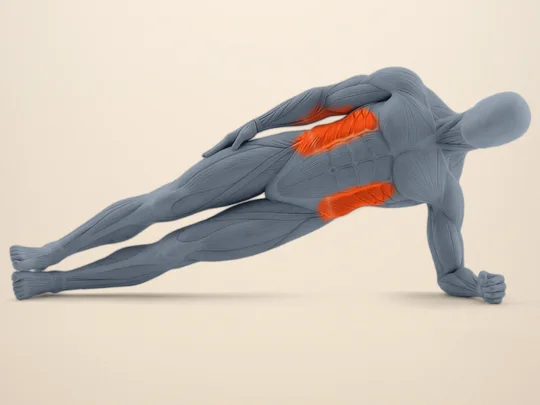
Side plank
Trains: external and internal obliques, the muscles along the side of your lower back and the outer hip.
How to do it: Lie on your side with your bottom elbow under your shoulder. Stack your feet, or stagger them for balance, and lift your hips until your body forms a straight line from head to feet. Hold for 20 to 45 seconds on each side.
Why it works: In the same 8-plank study, the side plank produced about 62% of maximum external oblique activity compared with 37% in the front plank, and more lower back muscle activity (Calatayud and colleagues, 2017, as tabulated by Oliva-Lozano and Muyor, 2020).
Common mistake: letting the top hip roll forward or sinking into the bottom shoulder. Push the floor away with your forearm.
Easier or harder: bend your knees to 90 degrees and balance on your bottom knee to make it easier. Lift your top leg to make it harder, or see our oblique exercises at home for more.
Key takeaways
- Hold each plank only while your form stays clean. For most people that is 2 to 4 sets of 20 to 60 seconds, 3 to 4 days a week.
- College-aged men had a median hold of 110 seconds and women 72 seconds, so older or less active adults should expect less (Strand and colleagues, 2014).
- Once 60 seconds feels easy, switch to a long-lever, roll-out or suspended plank, which work the abs much harder.
- Add side planks, which train the obliques and lower back muscles more than a front plank.
- Planks build endurance but do not reduce belly fat on their own (Vispute and colleagues, 2011).
Frequently asked questions
How long should a beginner hold a plank?
Start with 3 or 4 sets of 15 to 25 seconds, resting 30 to 45 seconds between them. Stop each set when your hips start to sag. If you cannot hold 15 seconds with a flat back, put your forearms on a bench or sofa until you can, then move to the floor.
Is holding a plank for 1 minute a day enough?
It is a good start and a useful habit. You will get more from 2 to 4 sets on 3 or 4 days a week, plus side planks. Once a minute feels easy, a harder variation will train your abs more than adding time (Schoenfeld and colleagues, 2014).
Is there any benefit to holding a plank for 5 minutes?
It mostly tests your patience, arms and legs. In the college study, most people stopped because of leg or arm fatigue, not their abs (Strand and colleagues, 2014). Harder variations reach much higher ab activity within seconds (Calatayud and colleagues, 2017), so short, hard sets are a better use of your time.
Do planks burn belly fat?
No. In a 6-week trial, abdominal exercise done 5 days a week improved endurance but did not change belly fat or waist size when diet stayed the same (Vispute and colleagues, 2011). Whether your abs show depends on your overall body fat level.
Why does my lower back hurt when I plank?
Usually your hips are sagging, or you are holding past the point where your form fails. Shorten your sets, squeeze your glutes to flatten your lower back, and use a bench or your knees until it feels comfortable. If the pain continues, stop planking and have it checked.
Safety note
This guide is general fitness information, not medical advice. Breathe steadily through every plank, because holding your breath raises blood pressure during the effort. Stop if you feel sharp pain in your back, shoulders or wrists. Check with a doctor or physiotherapist before starting planks if you have back pain, a back or shoulder injury, a hernia, high blood pressure or heart disease, or if you are pregnant or postpartum.
Sources
- Strand SL, Hjelm J, Shoepe TC, Fajardo MA. Norms for an isometric muscle endurance test. Journal of Human Kinetics. 2014;40(1):93-102. doi:10.2478/hukin-2014-0011
- Schoenfeld BJ, Contreras B, Tiryaki-Sonmez G, Willardson JM, Fontana F. An electromyographic comparison of a modified version of the plank with a long lever and posterior tilt versus the traditional plank exercise. Sports Biomechanics. 2014;13(3):296-306. doi:10.1080/14763141.2014.942355
- Calatayud J, Casaña J, Martín F, Jakobsen MD, Colado JC, Andersen LL. Progression of core stability exercises based on the extent of muscle activity. American Journal of Physical Medicine & Rehabilitation. 2017;96(10):694-699. doi:10.1097/PHM.0000000000000713
- Oliva-Lozano JM, Muyor JM. Core muscle activity during physical fitness exercises: a systematic review. International Journal of Environmental Research and Public Health. 2020;17(12):4306. doi:10.3390/ijerph17124306
- Aleais DAS, Sullivan K, Ferreira P, Marchetti PN, Marchetti PH. Acute dose-response of duration during the isometric forearm plank exercise on muscle thickness, echo-intensity, peak force, and perception of effort in recreationally-trained participants. International Journal of Exercise Science. 2022;15(6):676-685. doi:10.70252/RDKT2873
- McGill SM, Childs A, Liebenson C. Endurance times for low back stabilization exercises: clinical targets for testing and training from a normal database. Archives of Physical Medicine and Rehabilitation. 1999;80(8):941-944. doi:10.1016/s0003-9993(99)90087-4
- Wang XQ, Zheng JJ, Yu ZW, et al. A meta-analysis of core stability exercise versus general exercise for chronic low back pain. PLoS ONE. 2012;7(12):e52082. doi:10.1371/journal.pone.0052082
- Edwards JJ, Deenmamode AHP, Griffiths M, et al. Exercise training and resting blood pressure: a large-scale pairwise and network meta-analysis of randomised controlled trials. British Journal of Sports Medicine. 2023;57(20):1317-1326. doi:10.1136/bjsports-2022-106503
- Vispute SS, Smith JD, LeCheminant JD, Hurley KS. The effect of abdominal exercise on abdominal fat. Journal of Strength and Conditioning Research. 2011;25(9):2559-2564. doi:10.1519/JSC.0b013e3181fb4a46
Change log: 28 Nov 2026, first published. Every study checked against its abstract and DOI.
Related guides