Home / Abs / Lower Abs Workout at Home
Lower Abs Workout at Home: 4 Exercises and a 12-Minute Routine
By Fitness ScienceUpdated 9 min read7 peer-reviewed studiesEditorial policy
- No equipment
- All levels
- Lower abs
On this page
Most lower ab routines are fast leg kicks that mostly work your hip flexors and arch your lower back. This guide covers what the research says about "lower abs", how to keep the work in your stomach and which four floor exercises to use. The 12-minute routine works on its own or as part of our full no-equipment abs workout.
Can you target your lower abs?
Your "six-pack" is one muscle, the rectus abdominis, running from your lower ribs and breastbone to your pubic bone. There is no separate lower ab muscle, so researchers have tested whether some exercises make its lower part work harder.
A tightly controlled study found no difference. Lehman and McGill (2001) measured muscle activity (EMG) in 11 lean, athletic students during curl-ups, abdominal lifts and leg raises, while controlling spine position and range of motion. Upper and lower rectus activity did not differ within or between the exercises. The authors concluded that any differences are small and may not matter in practice.
Other studies found a small lower bias with good technique. Sarti and colleagues (1996) compared curl-ups with posterior pelvic tilts (curling the pelvis up toward the ribs) in 33 healthy adults. The curl-up worked the upper part harder in people with good form. Only trained people with good form (1.5 hours, 3 days a week for 3 years) worked the lower part harder with the pelvic tilt, and people with poor form activated both parts about the same. Willett and colleagues (2001) tested five exercises in 25 healthy adults and found the reverse curl produced the most lower rectus activity, while upper rectus activity was similar across most of the moves.
So every rep trains the whole muscle. Moves that start at the pelvis may shift a little more work to the lower part, but in these studies that only showed up when people did the tilt well.
Why your hip flexors take over
If you feel leg raises in the front of your hips or your lower back, your hip flexors are doing most of the work. They lift your thighs, while your abs curl your pelvis toward your ribs and stop your back from arching. When your legs swing and your back lifts, the abs do less.
Workman and colleagues (2008) had 16 men hold both straight legs about 5 cm (2 in) above a board with the pelvis tilted forward, neutral or tilted back. Upper and lower rectus activity was significantly higher with the pelvis tilted back than tilted forward. Hip flexor activity did not change between the three positions, so tucking helps your abs without switching off your hip flexors.
With the pelvis tucked, leg lowering is hard work for the abs. Shields and Heiss (1997) used a sensor on the pelvis so 15 men held the same backward tilt during a bent-knee curl and a double straight leg lower. The leg lower produced significantly more abdominal activity than the curl.
Harder versions can load the hip flexors heavily too. In 21 adults aged 23 to 43, a reverse crunch on a 30-degree incline bench was among the top exercises for both rectus abdominis and rectus femoris (a hip flexor) activity, which the authors said may be a problem for some people with low back pain (Escamilla and colleagues, 2006).
Two common cues work against you:
- Hands under your lower back. This props your spine up, so you never learn to hold the tilt yourself. Keep your palms by your sides.
- Sucking your belly button in. In Willett and colleagues (2001), this "vacuum" produced very low rectus abdominis activity. For these exercises, breathe out, pull your ribs down and curl your tailbone up instead.
4 lower ab exercises you can do at home
Move slowly on a mat, and end the set as soon as your lower back lifts off the floor.
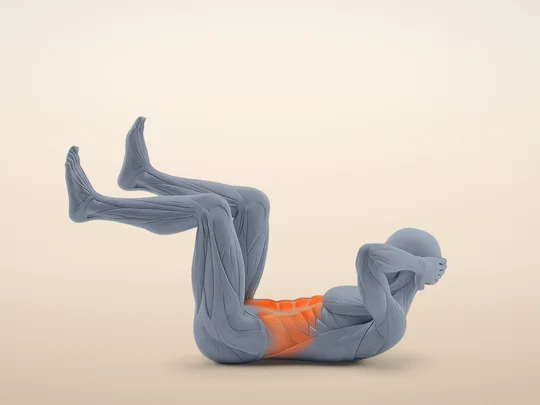
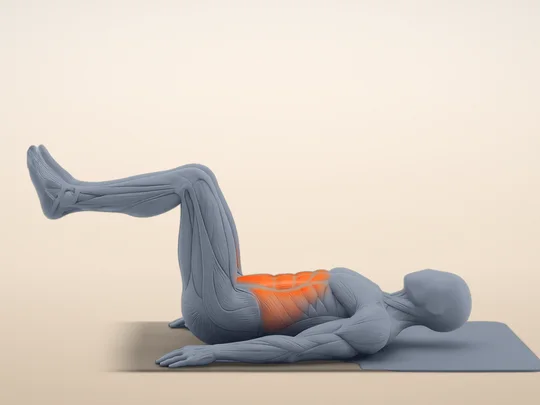
1. Reverse crunch
Trains: the rectus abdominis from the bottom up, plus the obliques.
How to do it: Lie on your back with your arms by your sides and your hips and knees bent to 90 degrees. Breathe out, press your lower back down and curl your tailbone 2.5 to 5 cm (1 to 2 in) off the floor toward your ribs. Pause for 1 second, then uncurl over 3 seconds.
Why it works: The reverse curl produced the most lower rectus activity of the five exercises Willett and colleagues (2001) tested, and a clean pelvic tilt is what gave trained people a lower-ab bias in Sarti and colleagues (1996).
Common mistake: swinging your knees toward your face or shoving down with your palms. Keep your hip angle fixed so the movement comes from your pelvis.
Easier or harder: tap your feet down between reps to reset. Slow the lowering to 4 seconds to make it harder.
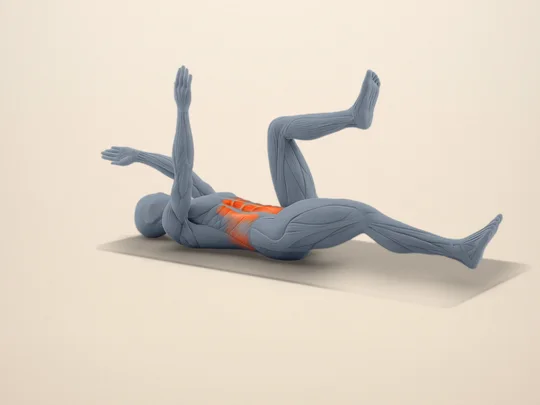
2. Dead bug
Trains: the rectus abdominis and obliques, which work to stop your lower back from arching.
How to do it: Lie on your back with your arms pointing at the ceiling and your hips and knees bent to 90 degrees. Press your lower back flat. Breathe out as you straighten your right leg toward the floor, stopping 10 to 15 cm (4 to 6 in) above it, and reach your left arm overhead. Return and switch sides. Our dead bug exercise guide covers every progression.
Why it works: It is a one-leg version of the leg lower in Shields and Heiss (1997): your abs hold the pelvic tilt while a straight leg tries to pull your back into an arch.
Common mistake: letting your ribs flare up and your back arch as the leg gets low. Only lower as far as your back stays flat.
Easier or harder: keep the knee bent and tap your heel down. To progress, hold the straight leg 5 cm (2 in) off the mat for 2 seconds.
3. Bent-knee leg lower
Trains: the rectus abdominis and obliques against a growing lever.
How to do it: Lie on your back, arms by your sides, knees bent and shins level as in the dead bug. Flatten your lower back. Breathe out and lower both feet toward the floor over 3 seconds without changing the knee angle. Touch your heels down lightly and bring them back up.
Why it works: Lowering both legs while you keep the pelvis tucked gave more abdominal activity than a curl (Shields and Heiss, 1997), and a tucked pelvis raised rectus activity compared with a forward tilt (Workman and colleagues, 2008).
Common mistake: letting your back peel off the floor at the bottom. If it does, stop the range higher.
Easier or harder: lower one leg at a time to make it easier. Straighten your knees a little more each week to make it harder.
4. Tuck-up to V-up
Trains: the whole rectus abdominis and the external obliques.
How to do it: Lie flat with your legs straight and arms overhead. Brace and press your lower back down. Lift your shoulders and legs at the same time and reach toward your shins, then lower over 2 to 3 seconds.
Why it works: In Willett and colleagues (2001), the V-sit was one of the two exercises with the most external oblique activity, with upper rectus activity similar to a trunk curl.
Common mistake: dropping your legs fast and arching hard at the bottom. Control the way down.
Easier or harder: bend your knees into a tuck-up, or lift one leg at a time. To make it harder, keep your heels 10 cm (4 in) off the floor between reps.
12-minute lower abs workout at home
Do this circuit 2 to 3 times a week on non-consecutive days. Complete 3 rounds and rest 60 seconds after each round.
| Order | Exercise | Beginner | Intermediate | Rest |
|---|---|---|---|---|
| 1 | Reverse crunch | 8 to 10 reps | 12 to 15 reps | 15 sec |
| 2 | Dead bug | 6 per side, bent knee | 8 to 10 per side, straight leg | 15 sec |
| 3 | Bent-knee leg lower | 6 to 8 reps, one leg | 8 to 10 reps, both legs | 15 sec |
| 4 | Tuck-up or V-up | 6 to 8 tuck-ups | 10 to 12 V-ups | 60 sec |
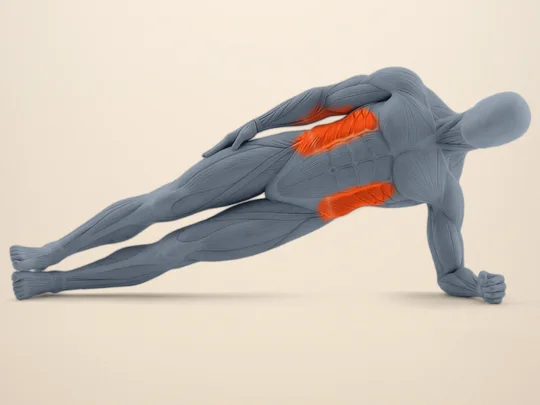
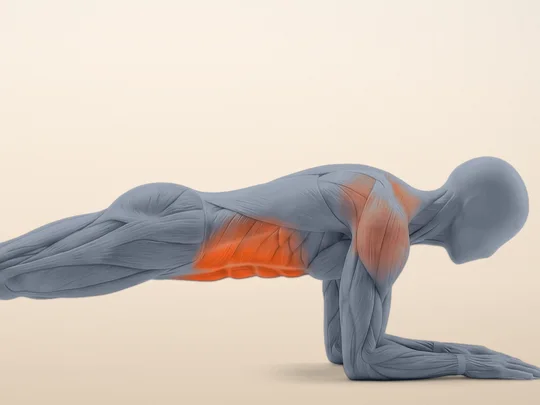
When you reach the top of the rep range with clean form, change one thing: slow the lowering to 4 seconds, add a 2-second pause, or straighten your legs a little more while your lower back stays flat. To round out a core session, add a plank (see plank benefits and how long to hold) and a few oblique exercises at home.
Will this burn lower belly fat?
No. In a randomized trial, 24 sedentary adults aged 18 to 40 either did 7 ab exercises (2 sets of 10, 5 days a week for 6 weeks) or no training, while eating to maintain their weight. The training group did more curl-ups at the end (47 versus 32), but there was no significant change in body weight, body fat, waist size or belly skinfolds (Vispute and colleagues, 2011).
Whether your lower abs show depends on how much body fat covers them, which comes down to your overall diet and activity. Train them for strength and back control.
Key takeaways
- The rectus abdominis is one muscle; a tightly controlled study found no difference in upper and lower activity.
- Curling your pelvis back raises rectus activity and may shift a little work to the lower part, but only with good form.
- Start with reverse crunches, dead bugs and bent-knee leg lowers, and stop each rep before your lower back lifts.
- Six weeks of ab training five days a week improved endurance but did not reduce belly fat.
Frequently asked questions
Are lower abs a separate muscle?
No. They are the bottom part of the rectus abdominis, which works as one muscle. Lehman and McGill (2001) found no difference between upper and lower activity. Some studies show a small lower bias during pelvic tilts and reverse curls, but only when people did them with good form (Sarti and colleagues, 1996).
Why do I feel lower ab exercises in my hip flexors?
Your hip flexors lift your legs, and tilting your pelvis back did not reduce their activity during a straight-leg hold (Workman and colleagues, 2008). Bend your knees to shorten the lever, move slowly, keep your lower back flat and start each rep by curling your tailbone toward your ribs.
Why do lower ab workouts hurt my lower back?
Usually your legs pull your pelvis into a forward tilt faster than your abs can stop it, so your lower back arches. Shorten the range, switch to bent-knee dead bugs or small reverse crunches, and stop each rep before your back lifts. If the pain is sharp or lasts, see a physiotherapist.
How often should I train lower abs?
Two to three times a week on non-consecutive days is plenty for most people, and the rest days help you keep each rep slow and controlled. More sessions will not burn belly fat: 6 weeks of ab training 5 days a week did not reduce it (Vispute and colleagues, 2011).
Safety note
This guide is general fitness information, not medical advice. Stop if you feel sharp lower back pain, a pinch in the groin, pressure in your pelvic floor or a ridge bulging along the middle of your stomach. If you have back pain, a disc injury, a hernia, recent abdominal surgery, or you are pregnant or postpartum, check with a doctor or physiotherapist before doing curls and leg lowering exercises.
Sources
- Lehman GJ, McGill SM. Quantification of the differences in electromyographic activity magnitude between the upper and lower portions of the rectus abdominis muscle during selected trunk exercises. Physical Therapy. 2001;81(5):1096-1101. doi:10.1093/ptj/81.5.1096
- Sarti MA, Monfort M, Fuster MA, Villaplana LA. Muscle activity in upper and lower rectus abdominus during abdominal exercises. Archives of Physical Medicine and Rehabilitation. 1996;77(12):1293-1297. doi:10.1016/s0003-9993(96)90195-1
- Willett GM, Hyde JE, Uhrlaub MB, Wendel CL, Karst GM. Relative activity of abdominal muscles during commonly prescribed strengthening exercises. Journal of Strength and Conditioning Research. 2001;15(4):480-485. doi:10.1519/00124278-200111000-00013
- Workman JC, Docherty D, Parfrey KC, Behm DG. Influence of pelvis position on the activation of abdominal and hip flexor muscles. Journal of Strength and Conditioning Research. 2008;22(5):1563-1569. doi:10.1519/JSC.0b013e3181739981
- Shields RK, Heiss DG. An electromyographic comparison of abdominal muscle synergies during curl and double straight leg lowering exercises with control of the pelvic position. Spine. 1997;22(16):1873-1879. doi:10.1097/00007632-199708150-00012
- Escamilla RF, Babb E, DeWitt R, et al. Electromyographic analysis of traditional and nontraditional abdominal exercises: implications for rehabilitation and training. Physical Therapy. 2006;86(5):656-671. doi:10.1093/ptj/86.5.656
- Vispute SS, Smith JD, LeCheminant JD, Hurley KS. The effect of abdominal exercise on abdominal fat. Journal of Strength and Conditioning Research. 2011;25(9):2559-2564. doi:10.1519/JSC.0b013e3181fb4a46
Change log: 28 Nov 2026, first published. Every study checked against its abstract and DOI.
Related guides