Home / Abs / Oblique Exercises at Home
Oblique Exercises at Home: 5 Bodyweight Moves and a Simple Plan
By Fitness ScienceUpdated 9 min read8 peer-reviewed studiesEditorial policy
- No equipment
- All levels
- Obliques
On this page
Your obliques are the muscles on the sides of your waist. This guide covers the home moves with the best evidence, how to do them and a short workout you can add to our full no-equipment abs workout.
What your obliques do
You have two layers on each side. The external obliques sit on top and run down and in from your lower ribs, like hands sliding into front pockets. The internal obliques sit underneath and run the other way. When you turn left, your right external oblique and left internal oblique work together.
A good routine covers three jobs: resisting side bending (side planks), resisting rotation while your limbs move (dead bugs) and turning your ribcage slowly (bicycle crunches, Russian twists).
What the research shows
Studies measure muscle activity with electromyography (EMG), as a percentage of a maximal contraction (% MVIC). It shows roughly which moves load the obliques most, though it does not measure muscle growth.
| Exercise | External oblique activity | Study |
|---|---|---|
| Side plank on toes | 62% MVIC | Escamilla and colleagues, 2016 |
| Side plank on knees | 37% MVIC | Escamilla and colleagues, 2016 |
| Rotational side plank (bottom side) | 62.8% MVIC | Youdas and colleagues, 2014 |
| Bent-knee sit-up | 36% MVIC | Escamilla and colleagues, 2016 |
| Crunch | 28% MVIC | Escamilla and colleagues, 2016 |
Side positions beat crunches and sit-ups for the external obliques in 18 adults (Escamilla and colleagues, 2016). Of nine exercises tested in 30 adults, the side-bridge was the only one to push the external oblique past the 45% MVIC level the authors linked to strength gains (Ekstrom and colleagues, 2007).
The best bodyweight oblique exercises
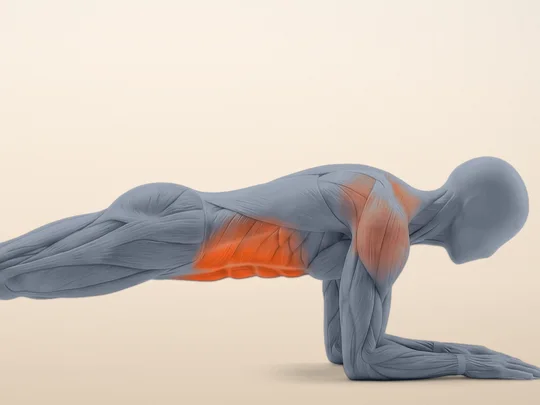
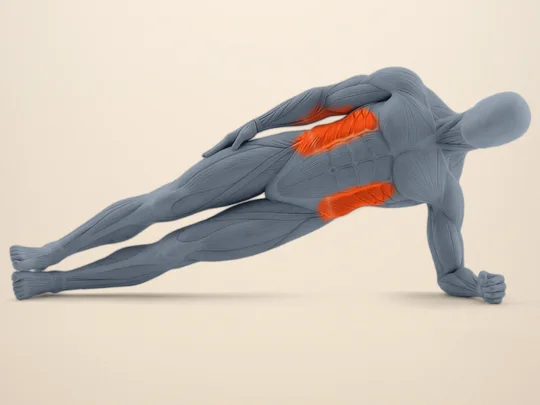
1. Elbow side plank
Trains: the bottom-side obliques, side hip muscles and lower-back muscles.
How to do it: Lie on your side with your elbow directly under your shoulder. Stack your feet, press your forearm into the floor, squeeze your glutes and lift your hips until your body is straight from head to heels. Hold for 20 to 40 seconds, breathing steadily, then switch sides.
Why it works: Gravity pulls your hips down the whole time. In 25 adults, the bottom external oblique worked at 37.2% MVIC against 11.7% on top (Youdas and colleagues, 2014), so train both sides equally. Side planks also gave the highest lower-back muscle activity of eight plank variations in one study (Calatayud and colleagues, 2017). For front-plank targets, see plank benefits and how long to hold.
Common mistake: letting the bottom shoulder sink or rolling the top hip forward. Push the floor away and keep your chest facing sideways.
Easier or harder: bend your knees to 90 degrees and hold from the knees. To make it harder, add slow hip dips of 5 to 8 cm (2 to 3 in) or move to the rotational side plank.
2. Rotational side plank
Trains: the external obliques on both sides, rectus abdominis and side hip muscles.
How to do it: From a forearm plank, shift onto your right forearm and turn your whole body as one unit into a right side plank. Pause for 1 to 2 seconds, turn back, then go to the other side. Do 6 to 8 slow turns per side.
Why it works: It was the hardest move in its study for the external obliques, with both sides above 60% MVIC (Youdas and colleagues, 2014).
Common mistake: twisting at the waist while your hips lag behind. Turn your shoulders and hips together.
Easier or harder: do it from your knees to make it easier. Hold each side plank for 3 to 5 seconds to make it harder.
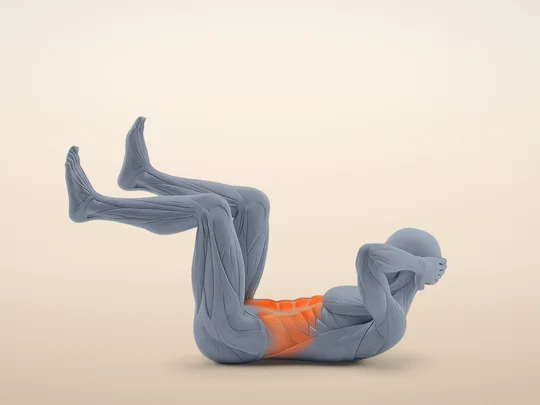
3. Slow bicycle crunch
Trains: the obliques and rectus abdominis.
How to do it: Lie on your back with your fingertips lightly behind your ears, elbows wide and knees bent at 90 degrees over your hips. Press your lower back gently into the floor. Breathe out, lift your shoulder blades, straighten your right leg about 30 to 45 cm (12 to 18 in) off the floor and turn your right ribcage toward your left knee. Pause for one second, then switch. Do 8 to 12 slow reps per side.
Why it works: In 32 adults, 13 with chronic low back pain, this slow criss-cross gave the highest trunk flexor activity of three Pilates moves and worked the obliques more than the rectus abdominis (Pereira and colleagues, 2017).
Common mistake: pulling on your neck and pedalling fast. Keep your elbows wide and aim your armpit at the opposite knee.
Easier or harder: keep the straight leg higher, about 60 degrees from the floor, to make it easier. Lower it to about 15 cm (6 in) and pause for 2 seconds on each breath out to make it harder.
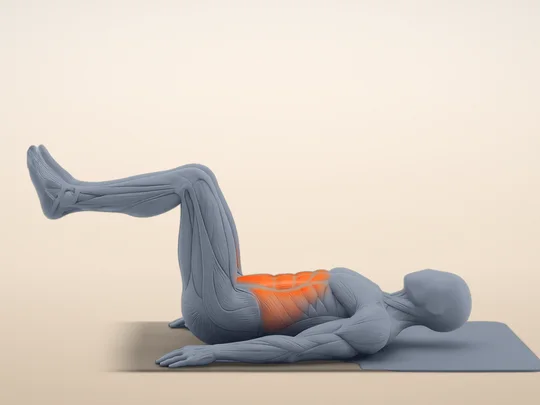
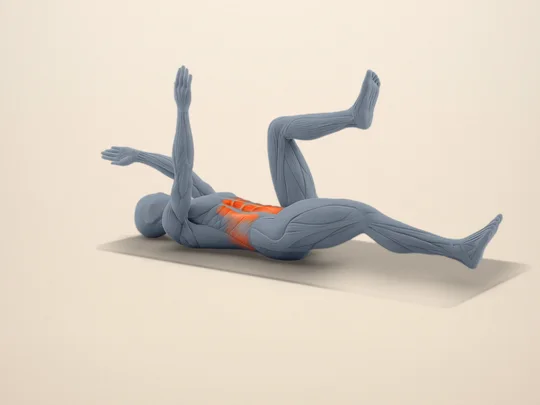
4. Dead bug
Trains: the obliques and deep abdominal muscles, mainly by resisting rotation and arching.
How to do it: Lie on your back with your arms straight above your shoulders and knees bent at 90 degrees over your hips. Breathe out to draw your ribs down and settle your lower back onto the floor. Lower your right arm overhead and straighten your left leg until your heel hovers 10 to 15 cm (4 to 6 in) above the floor, without letting your back arch. Return and switch. Do 8 to 10 reps per side.
Why it works: Moving opposite limbs tries to twist and arch your spine, and your obliques hold it still. In the same study, the dead bug also worked the obliques more than the rectus abdominis (Pereira and colleagues, 2017). Our dead bug exercise guide covers every variation.
Common mistake: dropping the leg fast until your lower back lifts. Lower on a 3-second count and stop before your ribs flare.
Easier or harder: keep your arms still and slide one heel out at a time to make it easier. To make it harder, press your still hand firmly into the opposite knee during each rep.
5. Tall-back Russian twist
Trains: the obliques, rectus abdominis and hip flexors.
How to do it: Sit with your knees bent and heels on the floor. Brace and lean back about 30 degrees with a straight back. With your hands clasped at your chest, breathe out and turn your ribcage right, back to the middle, then left. Do 8 to 12 smooth reps per side.
Why it works: Leaning back makes your trunk hold the position, and turning your ribcage over a still pelvis trains controlled rotation.
Common mistake: rounding your lower back and whipping your hands to the floor. In a lab study on pig spine segments, adding a small twist to repeated bending raised disc herniations from 29% to 71% (Drake and colleagues, 2005). It did not test Russian twists, but it is a good reason to sit tall and turn slowly.
Easier or harder: lean back less and use a smaller turn to make it easier. Once 3 sets of 12 feel solid, lift your heels 5 to 10 cm (2 to 4 in) or hold a 2 to 4 kg (5 to 10 lb) object close to your chest.
A 10 to 15 minute oblique workout
Do this 2 to 3 times a week on non-consecutive days, on its own or after the lower abs workout at home.
| Exercise | Beginner (2 to 3 rounds) | Intermediate (3 rounds) | Rest |
|---|---|---|---|
| Side plank | 20 to 30 seconds per side, knees or toes | 35 to 45 seconds per side, or rotational | 30 to 45 seconds |
| Dead bug | 6 to 8 slow reps per side | 10 to 12 reps per side with hand press | 30 seconds |
| Slow bicycle crunch | 8 reps per side, 1 second pause | 12 reps per side, 2 second pause | 30 to 45 seconds |
| Tall-back Russian twist | 8 reps per side, heels down | 10 to 12 reps per side, heels lifted | 30 to 45 seconds |
To progress, add a 2-second pause on the hardest part of each rep, move from knee to toe side planks and then to rotational ones, and go from 2 to 3 rounds once every set stays clean. Keep at least half your oblique work as holds, keep twists slow, and breathe out through the hardest second: a review of 67 studies reported 70.74% MVIC in the external oblique during curl-ups with a forceful breath out (Oliva-Lozano and Muyor, 2020).
Do oblique exercises get rid of love handles?
No. Training your obliques does not remove fat from the sides of your waist. In a 6-week trial, 24 sedentary adults did either 7 ab exercises (2 sets of 10, 5 days a week) or no ab training, on an unchanged diet. The ab group got better at curl-ups (47 reps against 32), but there was no change in body fat, waist circumference or the skinfold just above the hip bone, where love handles sit (Vispute and colleagues, 2011).
Whether you can see your obliques depends on how much fat covers them, and ab exercises alone did not change that fat. Train them for a stronger, steadier trunk.
Key takeaways
- Train all three oblique jobs: side planks for resisting side bending, dead bugs for resisting rotation, and slow bicycle crunches or Russian twists for controlled rotation.
- Side planks on your toes worked the external obliques harder than crunches or sit-ups (Escamilla and colleagues, 2016), and rotational side planks pushed both sides above 60% (Youdas and colleagues, 2014).
- Keep twists slow with a tall back, and breathe out on the hardest part of each rep.
- Oblique exercises build strength and endurance but do not burn side fat (Vispute and colleagues, 2011).
Frequently asked questions
What are the best oblique exercises at home without equipment?
Side planks and rotational side planks have the strongest evidence. In lab studies they pushed external oblique activity above 60% of maximum. Add dead bugs and slow bicycle crunches, which both worked the obliques more than the rectus abdominis, and you have a complete routine that needs only a bit of floor space.
Do oblique exercises reduce love handles?
No. In a 6-week trial, adults who did ab exercises 5 days a week improved their curl-up endurance but had no change in body fat, waist size or the skinfold above the hip (Vispute and colleagues, 2011). Ab training alone did not shift side fat, so treat oblique work as strength training for your trunk.
Are Russian twists bad for your lower back?
Fast, slouched or heavily loaded twists are the riskiest version. A lab study on pig spines found that adding a twist to repeated bending raised disc damage (Drake and colleagues, 2005). Sit tall, keep your heels down and turn from your ribcage, or use side planks and dead bugs instead if your back is sensitive.
How often should I train my obliques?
Two to three sessions a week on non-consecutive days works for most people. Each session can be short: 3 or 4 moves for 2 to 3 rounds takes about 10 to 15 minutes. Your obliques also work during planks and other ab exercises, so you don't need a separate session every day.
Safety note
This guide is general fitness information, not medical advice. Stop if you feel sharp lower-back pain, tingling down a leg, pain in your groin or a pinch in your shoulder. Check with a doctor or physiotherapist before starting if you have back pain, a disc problem, a hernia, abdominal separation (diastasis recti) or recent surgery, or if you are pregnant or postpartum.
Sources
- Escamilla RF, Lewis C, Pecson A, Imamura R, Andrews JR. Muscle activation among supine, prone, and side position exercises with and without a Swiss ball. Sports Health. 2016;8(4):372-379. doi:10.1177/1941738116653931
- Ekstrom RA, Donatelli RA, Carp KC. Electromyographic analysis of core trunk, hip, and thigh muscles during 9 rehabilitation exercises. Journal of Orthopaedic & Sports Physical Therapy. 2007;37(12):754-762. doi:10.2519/jospt.2007.2471
- Youdas JW, Boor MM, Darfler AL, Koenig MK, Mills KM, Hollman JH. Surface electromyographic analysis of core trunk and hip muscles during selected rehabilitation exercises in the side-bridge to neutral spine position. Sports Health. 2014;6(5):416-421. doi:10.1177/1941738114539266
- Oliva-Lozano JM, Muyor JM. Core muscle activity during physical fitness exercises: a systematic review. International Journal of Environmental Research and Public Health. 2020;17(12):4306. doi:10.3390/ijerph17124306
- Pereira ILR, Queiroz B, Loss J, Amorim C, Sacco ICN. Trunk muscle EMG during intermediate Pilates mat exercises in beginner healthy and chronic low back pain individuals. Journal of Manipulative and Physiological Therapeutics. 2017;40(5):350-357. doi:10.1016/j.jmpt.2017.02.010
- Calatayud J, Casaña J, Martín F, Jakobsen MD, Colado JC, Andersen LL. Progression of core stability exercises based on the extent of muscle activity. American Journal of Physical Medicine & Rehabilitation. 2017;96(10):694-699. doi:10.1097/PHM.0000000000000713
- Drake JD, Aultman CD, McGill SM, Callaghan JP. The influence of static axial torque in combined loading on intervertebral joint failure mechanics using a porcine model. Clinical Biomechanics. 2005;20(10):1038-1045. doi:10.1016/j.clinbiomech.2005.06.007
- Vispute SS, Smith JD, LeCheminant JD, Hurley KS. The effect of abdominal exercise on abdominal fat. Journal of Strength and Conditioning Research. 2011;25(9):2559-2564. doi:10.1519/JSC.0b013e3181fb4a46
Change log: 28 Nov 2026, first published. Every study checked against its abstract and DOI.
Related guides