Home / Chest / Decline Push-Ups for the Upper Chest
Decline Push-Ups for the Upper Chest: Best Foot Height and Form
By Fitness ScienceUpdated 7 min read8 peer-reviewed studiesEditorial policy
- Bench or chair
- Intermediate
- Upper chest
On this page
The decline push-up is one of the moves in our full no-equipment chest workout. It is the simplest way to bias the upper chest at home, as long as you get the foot height and arm path right.
Why decline push-ups target the upper chest
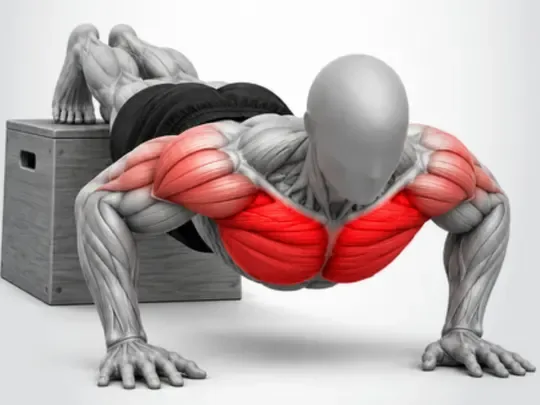
The name confuses people, because a decline bench press works the lower chest. The difference is which way you face. On a decline bench you lie face up with your head low, so you press toward your lower ribs. In a decline push-up you face the floor with your feet high, so you press toward your collarbone. That matches an incline bench press, which favours the upper chest.
Research on incline pressing backs this up. In one study, upper-chest activity during part of the press was higher on a 30 or 45 degree bench than on a flat or decline bench (Lauver and colleagues, 2016). In an 8-week training study of 47 untrained men, the incline bench press group grew more muscle at the upper-chest site than the flat bench group (Chaves and colleagues, 2020). And push-ups themselves can build chest muscle about as well as a light bench press (Kikuchi and Nakazato, 2017).
Muscles worked
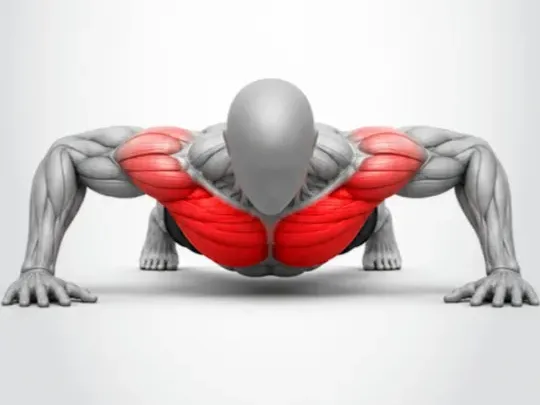
- Upper chest (clavicular pectoralis major): the fibers that run up toward your collarbone, which line up best with an upward press (Trebs and colleagues, 2010).
- Middle and lower chest: still working, but these fibers were most active on a flat bench (Rodríguez-Ridao and colleagues, 2020).
- Front delts: they take on more of the work as the angle gets steeper (Rodríguez-Ridao and colleagues, 2020).
- Triceps: they straighten your elbows. Their activity stayed similar across bench angles in the same study.
- Serratus anterior and core: they hold your shoulder blades and keep your hips from sagging.
The best foot height
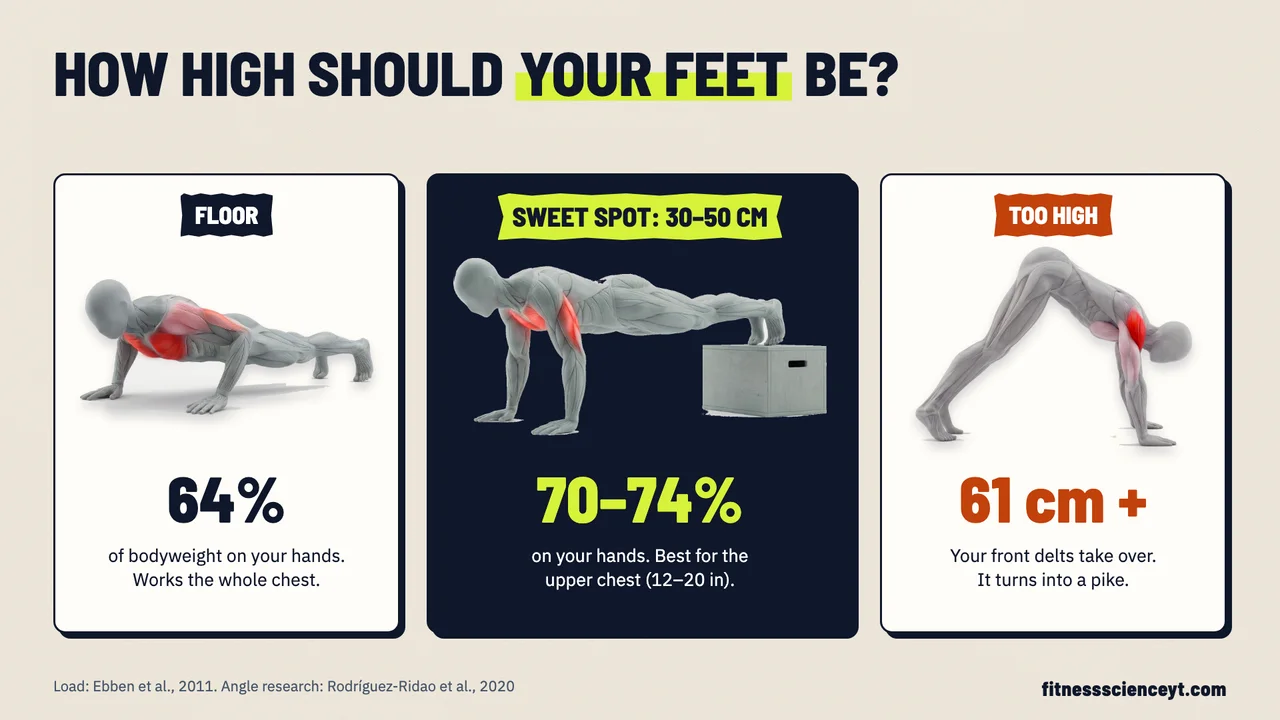
Higher feet make the push-up heavier. A force-plate study measured hand load at 64% of bodyweight on the floor, 70% with feet raised 30 cm (12 in) and 74% with feet raised 61 cm (24 in) (Ebben and colleagues, 2011).
But there is a ceiling. In bench press research, upper-chest activity peaked at a 30 degree angle, and above 45 degrees the front delts took over (Rodríguez-Ridao and colleagues, 2020). A 2026 study of suspension push-ups found the same thing: the most steeply declined position shifted work onto the front delts, triceps, upper traps and serratus (Lin and colleagues, 2026).
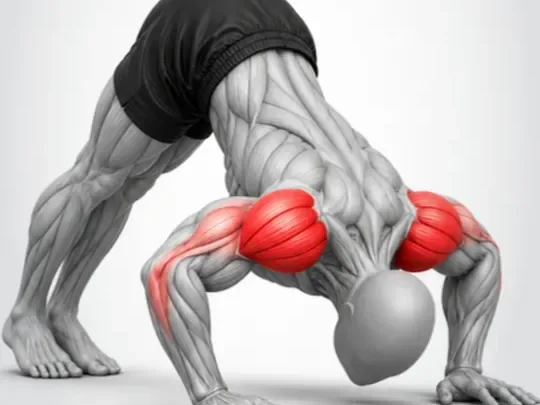
So for most people, a bench, chair or couch 30 to 50 cm (12 to 20 in) high is ideal. Go much higher and the move starts to turn into a pike push-up, which is a shoulder exercise.
| Setup | Hand load | Main target |
|---|---|---|
| Hands raised 61 cm (24 in) | about 41% of bodyweight | Easier chest press |
| Floor push-up | about 64% | Whole chest, mostly middle and lower |
| Feet raised 30 cm (12 in) | about 70% | Upper chest |
| Feet raised 61 cm (24 in) | about 74% | Upper chest and front delts |
| Feet much higher | more than 74% (estimate) | Mostly front delts |
Load figures are from Ebben and colleagues (2011). The last row is our estimate, since the study stopped at 61 cm.
How to do a decline push-up
Trains: upper and middle chest, front delts, triceps, serratus anterior and core.
How to do it: Put your toes on a bench or chair 30 to 50 cm (12 to 20 in) high. Place your hands on the floor about shoulder width apart or slightly wider. Squeeze your stomach and glutes so your body is a straight line. Lower over about 2 seconds, keeping your elbows around 30 to 45 degrees from your body, until your chest is just above the floor. Press back up.
Why it works: Raised feet put more of your bodyweight on your hands and angle the press toward your collarbone, where the upper-chest fibers pull.
Common mistake: letting your hips sag, or using a surface so high that your shoulders do all the work.
Easier or harder: use a low step, about 15 cm (6 in), to make it easier. Add a pause at the bottom, slow the lowering phase, or wear a weighted vest to make it harder.
Hand width matters too. Narrower hands produced more chest activity than wide hands in standard push-ups (Cogley and colleagues, 2005). Our guide to wide vs close-grip push-ups covers that in detail.
Common mistakes
- Sagging hips. Brace your stomach and glutes. If your hips still dip, lower the surface.
- Feet too high. Above about 61 cm (24 in), the shoulders take over.
- Elbows flared to 90 degrees. Keep them at 30 to 45 degrees to protect your shoulders.
- Half reps. Lower until your chest is close to the floor every time.
- Neck craned forward. Keep your head in line with your body.
Regressions and progressions
Not ready yet? Build up to 12 to 15 good floor push-ups first, then start with your feet on a low step, 10 to 20 cm (4 to 8 in) high.
Too easy? Keep the feet at bench height and make each rep harder instead of raising them further:
- Put your hands on parallettes or books so your chest can go lower.
- Lower over 3 seconds and pause for 1 second at the bottom.
- Wear a weighted vest or backpack.
- Move on to archer push-ups with your feet raised.
Sets, reps and weekly volume
Train decline push-ups twice a week. Do 3 to 4 sets of 8 to 20 reps, stopping each set with one or two good reps left, and rest about 90 to 120 seconds between sets. Pair them with flat push-ups so the whole chest gets work. For a full weekly plan, see how many push-ups it takes to build your chest.
Key takeaways
- Decline push-ups work like an incline press because you face the floor and press toward your collarbone.
- Raising your feet increases the load from about 64% of bodyweight on the floor to 70 to 74% (Ebben and colleagues, 2011).
- Use a surface 30 to 50 cm (12 to 20 in) high. Much higher and the front delts take over.
- Once you can do 20 reps, add a pause, slower lowering or extra weight instead of raising your feet further.
Frequently asked questions
Do decline push-ups work the upper or lower chest?
The upper chest. Facing the floor with your feet up angles the press like an incline bench press.
How high should my feet be?
About 30 to 50 cm (12 to 20 in), the height of a bench, chair or couch seat.
Are decline push-ups harder than regular push-ups?
Yes. Your hands carry about 70 to 74% of your bodyweight instead of 64% (Ebben and colleagues, 2011).
Can decline push-ups replace the incline bench press?
At home, they are the closest match. Push-ups taken close to failure can build chest muscle about as well as a light bench press (Kikuchi and Nakazato, 2017). Add load once sets of 20 feel easy.
Safety note
This guide is general fitness information, not medical advice. Raised feet put more load through your shoulders and wrists. If you have shoulder, wrist or lower-back pain, start on the floor or a low step, use push-up handles if your wrists hurt, and stop if you feel sharp pain. Check with a doctor or physiotherapist if pain continues.
Sources
- Ebben WP, Wurm B, VanderZanden TL, et al. Kinetic analysis of several variations of push-ups. Journal of Strength and Conditioning Research. 2011;25(10):2891-2894. doi:10.1519/JSC.0b013e31820c8587
- Rodríguez-Ridao D, Antequera-Vique JA, Martín-Fuentes I, Muyor JM. Effect of five bench inclinations on the electromyographic activity of the pectoralis major, anterior deltoid, and triceps brachii during the bench press exercise. International Journal of Environmental Research and Public Health. 2020;17(19):7339. doi:10.3390/ijerph17197339
- Lin Y-C, Chiang T-L, Chan S-H, et al. Angle-specific upper body muscle activation in suspension push-ups: an electromyographic analysis across different body angles. BMC Sports Science, Medicine and Rehabilitation. 2026;18:139. doi:10.1186/s13102-026-01582-3
- Lauver JD, Cayot TE, Scheuermann BW. Influence of bench angle on upper extremity muscular activation during bench press exercise. European Journal of Sport Science. 2016;16(3):309-316. doi:10.1080/17461391.2015.1022605
- Trebs AA, Brandenburg JP, Pitney WA. An electromyography analysis of 3 muscles surrounding the shoulder joint during the performance of a chest press exercise at several angles. Journal of Strength and Conditioning Research. 2010;24(7):1925-1930. doi:10.1519/JSC.0b013e3181ddfae7
- Chaves SFN, Rocha-Júnior VA, Encarnação IGA, et al. Effects of horizontal and incline bench press on neuromuscular adaptations in untrained young men. International Journal of Exercise Science. 2020;13(6):859-872. doi:10.70252/FDNB1158
- Kikuchi N, Nakazato K. Low-load bench press and push-up induce similar muscle hypertrophy and strength gain. Journal of Exercise Science & Fitness. 2017;15(1):37-42. doi:10.1016/j.jesf.2017.06.003
- Cogley RM, Archambault TA, Fibeger JF, et al. Comparison of muscle activation using various hand positions during the push-up exercise. Journal of Strength and Conditioning Research. 2005;19(3):628-633. doi:10.1519/15094.1
Related guides