Home / Chest / Wide vs Close-Grip Push-Ups
Wide vs Close-Grip Push-Ups: Which Builds More Chest?
By Fitness ScienceUpdated 7 min read8 peer-reviewed studiesEditorial policy
- No equipment
- All levels
- Hand width
On this page
A common gym tip says wide hands build the chest and close hands only train the arms. The research says otherwise. Here is what the studies found, how to do each version and how to fit them into a full no-equipment chest workout.
The differences at a glance
| Measure | Close grip | Standard | Wide grip |
|---|---|---|---|
| Hand position | About half shoulder width | About shoulder width | About 1.5x shoulder width |
| Chest activity | Highest or equal | High | Lower or equal |
| Triceps activity | Highest | Medium | Lowest |
| Elbow load | Highest | Medium | Lowest |
| Range of motion | Longest | Medium | Shortest |
This summary is based on Cogley and colleagues (2005), Marcolin and colleagues (2015), Kim and colleagues (2016), Intziegianni and colleagues (2026) and Donkers and colleagues (1993).
What the research shows
Chest: wide hands are not better
Study after study points the same way:
- In 40 adults, narrow-hand push-ups produced more chest and triceps activity than wide-hand push-ups (Cogley and colleagues, 2005).
- In 12 men tested at half, normal and one-and-a-half times shoulder width, chest activity was higher at the narrow and normal widths than the wide one (Kim and colleagues, 2016).
- In a study of 8 people, narrow push-ups produced more chest and triceps activity than wide ones (Marcolin and colleagues, 2015).
- In 20 young men, diamond push-ups produced the highest activity for both the chest and the triceps (Intziegianni and colleagues, 2026).
- One study found chest activity was similar across hand positions, with no advantage for wide hands (Youdas and colleagues, 2010).
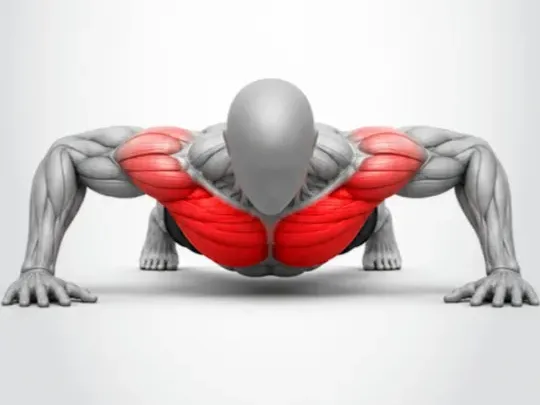
You also cannot isolate an "inner" or "outer" chest with hand width. The chest muscle runs from your breastbone and collarbone to your upper arm, and its fibers contract along their whole length.
Triceps and elbow load
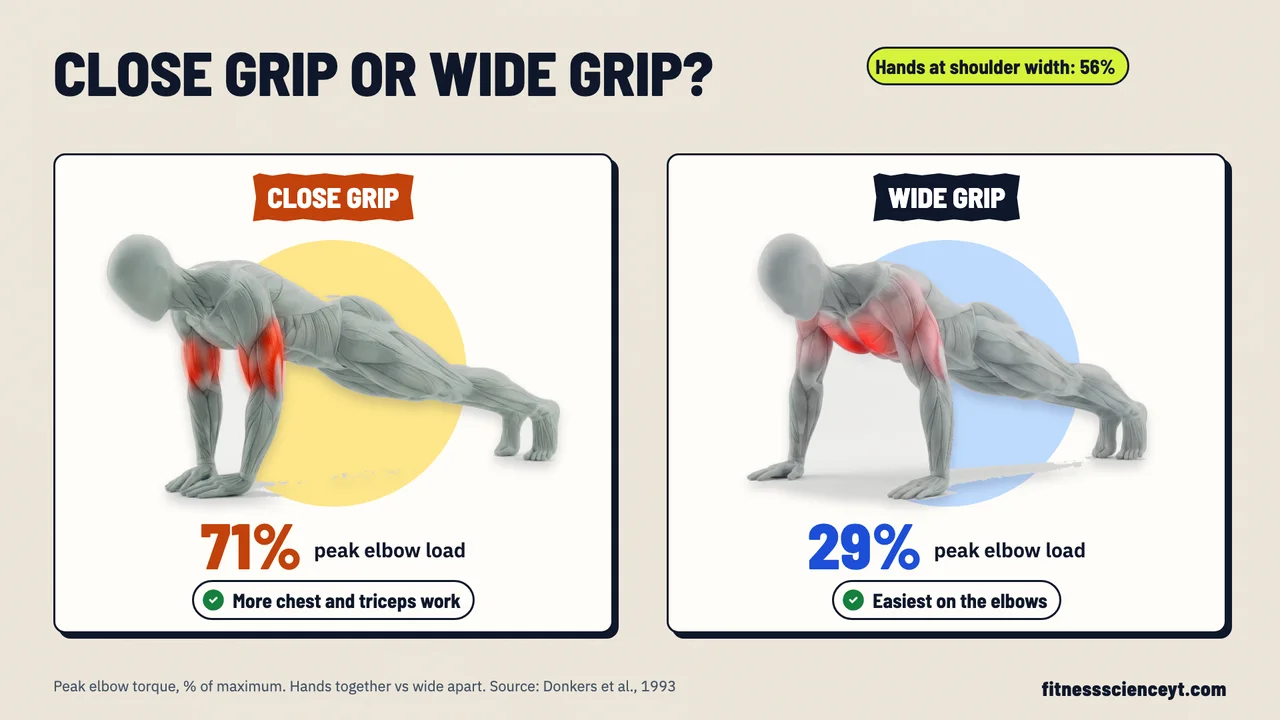
Narrow hands make your triceps work harder (Kim and colleagues, 2016). They also load the elbow more. In a force-plate study, the twisting force at the elbow was 71% of maximum with hands together, 56% at a normal width and only 29% with hands wide apart (Donkers and colleagues, 1993). That is why close-grip push-ups feel so much harder on the arms.
Shoulder stabilisers
Narrow hands also increased activity in the infraspinatus, a rotator cuff muscle, and the pectoralis minor (Kim and colleagues, 2016).
How to do wide-grip push-ups
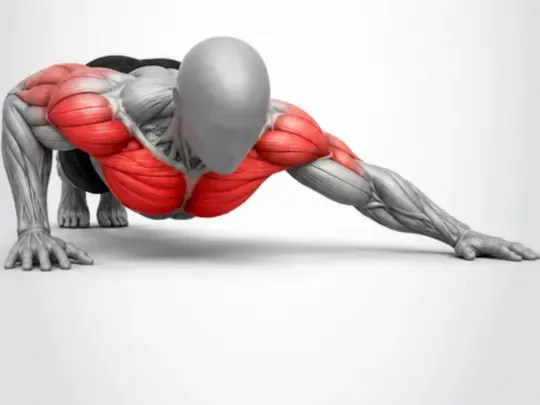
Trains: chest, front delts and core, with less triceps work.
How to do it: Place your hands about one and a half times shoulder width apart, fingers turned slightly out. Keep your elbows around 45 degrees from your body, not straight out to the sides. Lower over 2 to 3 seconds until your chest is just above the floor, then press up.
Why it works: Wide hands cut elbow load to less than half of a close grip (Donkers and colleagues, 1993). That makes this version useful when your elbows are sore or as a lighter second exercise.
Common mistake: flaring the elbows out to 90 degrees, so your body makes a T. In a study of the standard push-up, flared elbows reduced the shoulder-blade movement that keeps the joint comfortable (Suprak and colleagues, 2013).
Easier or harder: put your hands on a bench or drop to your knees to make it easier. Put your hands on blocks so you can go deeper to make it harder.
How to do close-grip push-ups
A close-grip push-up has your hands about a hand's width apart, below your lower chest. A diamond push-up goes further, with your thumbs and index fingers touching.
Trains: chest, triceps, the rotator cuff and core.
How to do it: Place your hands under your lower chest, a little narrower than your shoulders. Keep your elbows close to your sides as you lower over 2 to 3 seconds, until your chest nearly touches your hands. Press back up to straight arms.
Why it works: Close hands give you the longest range of motion and the most triceps work, while the chest works at least as hard as in a standard push-up (Kim and colleagues, 2016).
Common mistake: letting your wrists hurt and pushing through it. Turn your fingers slightly outward or hold hex dumbbells to keep your wrists straight.
Easier or harder: use an incline or your knees to make it easier. Move to diamond, decline or weighted push-ups to make it harder.
Common mistakes
- Elbows flared to 90 degrees. This is the main cause of shoulder discomfort in wide push-ups.
- Hands too far forward. Keep your wrists under or slightly below your shoulders, not ahead of them.
- Half reps. Lower until your chest is close to the floor.
- Wrong easier version. Raising your feet makes a push-up harder. To make it easier, raise your hands.
- Too much too soon. Close-grip work is hard on the elbows, so add sets gradually.
Which one should you choose?
- For chest and triceps size: close grip or standard.
- For sore elbows: wide grip, with your elbows kept under 60 degrees.
- For sensitive shoulders: close grip or standard, which keep your elbows in.
- On a push day: close-grip first while you are fresh, wide-grip second.
Regressions, progressions and programming
On your knees, your hands carry less of your weight: one study measured about 66% of bodyweight in a normal push-up and 53% on the knees (Gouvali and Boudolos, 2005). Start with incline or knee push-ups in our beginner home chest workout. Then move to floor push-ups, slower lowering, diamonds and feet-raised sets from our decline push-up guide.
Train 2 to 3 non-consecutive days a week. Do 3 to 4 sets of 8 to 20 reps, stopping with one or two good reps left, and rest 90 to 120 seconds. A simple pairing: 3 to 4 sets of close-grip push-ups, then 2 to 3 sets of wide push-ups. For total weekly volume, see how many push-ups it takes to build your chest.
Key takeaways
- Close and standard grips match or beat wide grips for chest activity, and clearly beat them for triceps.
- Wide push-ups shorten the range of motion and cut elbow load to less than half of a close grip.
- Keep your elbows under 60 degrees in wide push-ups to protect your shoulders.
- Train 3 to 4 sets of 8 to 20 reps, and add difficulty once you pass 20 clean reps.
Frequently asked questions
Do wide push-ups work the chest more than close-grip push-ups?
No. Several studies found that narrow and standard push-ups match or beat wide ones for chest activity (Cogley and colleagues, 2005; Kim and colleagues, 2016; Marcolin and colleagues, 2015).
Are close-grip push-ups the same as diamond push-ups?
Not quite. Close-grip push-ups have your hands a little narrower than your shoulders. Diamond push-ups have your thumbs and index fingers touching.
Are wide push-ups bad for your shoulders?
Only if you flare your elbows out to 90 degrees. Keep them at about 45 degrees and wide push-ups are fine for most people.
Why are close-grip push-ups so much harder?
They load the elbows much more: 71% of maximum torque with hands together vs 29% with hands wide (Donkers and colleagues, 1993). Your triceps do more of the work.
Safety note
This guide is general fitness information, not medical advice. Stop if you feel sharp shoulder, elbow or wrist pain. If you have a shoulder or elbow injury, start with push-ups against a bench or wall, use push-up handles if needed, and check with a physiotherapist before training on the floor.
Sources
- Cogley RM, Archambault TA, Fibeger JF, et al. Comparison of muscle activation using various hand positions during the push-up exercise. Journal of Strength and Conditioning Research. 2005;19(3):628-633. doi:10.1519/15094.1
- Kim Y-S, Kim D-Y, Ha M-S. Effect of the push-up exercise at different palmar width on muscle activities. Journal of Physical Therapy Science. 2016;28(2):446-449. doi:10.1589/jpts.28.446
- Marcolin G, Petrone N, Moro T, et al. Selective activation of shoulder, trunk, and arm muscles: a comparative analysis of different push-up variants. Journal of Athletic Training. 2015;50(11):1126-1132. doi:10.4085/1062-6050-50.9.09
- Intziegianni K, Katsamis E, Michaelides M, Parpa K. Electromyographic activation of the pectoralis major and triceps brachii muscles during standard, diamond, and wide hand position push-ups. Muscles. 2026;5(1):18. doi:10.3390/muscles5010018
- Youdas JW, Budach BD, Ellerbusch JV, et al. Comparison of muscle-activation patterns during the conventional push-up and perfect pushup exercises. Journal of Strength and Conditioning Research. 2010;24(12):3352-3362. doi:10.1519/JSC.0b013e3181cc23b0
- Donkers MJ, An KN, Chao EY, Morrey BF. Hand position affects elbow joint load during push-up exercise. Journal of Biomechanics. 1993;26(6):625-632. doi:10.1016/0021-9290(93)90026-b
- Gouvali MK, Boudolos K. Dynamic and electromyographical analysis in variants of push-up exercise. Journal of Strength and Conditioning Research. 2005;19(1):146-151. doi:10.1519/14733.1
- Suprak DN, Bohannon J, Morales G, et al. Scapular kinematics and shoulder elevation in a traditional push-up. Journal of Athletic Training. 2013;48(6):826-835. doi:10.4085/1062-6050-48.5.08
Related guides