Home / Chest / Chest Workout at Home for Beginners
Chest Workout at Home for Beginners: A No-Equipment Plan
By Fitness ScienceUpdated 9 min read8 peer-reviewed studiesEditorial policy
- No equipment
- Beginner
- 4-week plan
On this page
This plan works even if you cannot do a single floor push-up yet. It takes you from the wall to the floor step by step. Once floor push-ups feel easy, move on to our full no-equipment chest workout.
Why bodyweight training works for beginners
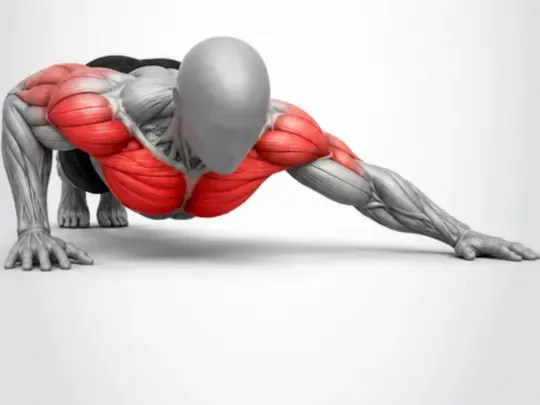
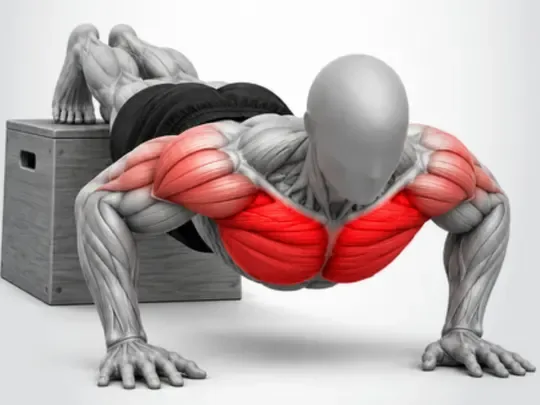
Your chest muscle, the pectoralis major, has an upper part near the collarbone and a larger lower part. Your front shoulders, triceps and the serratus anterior on your ribs help it push.
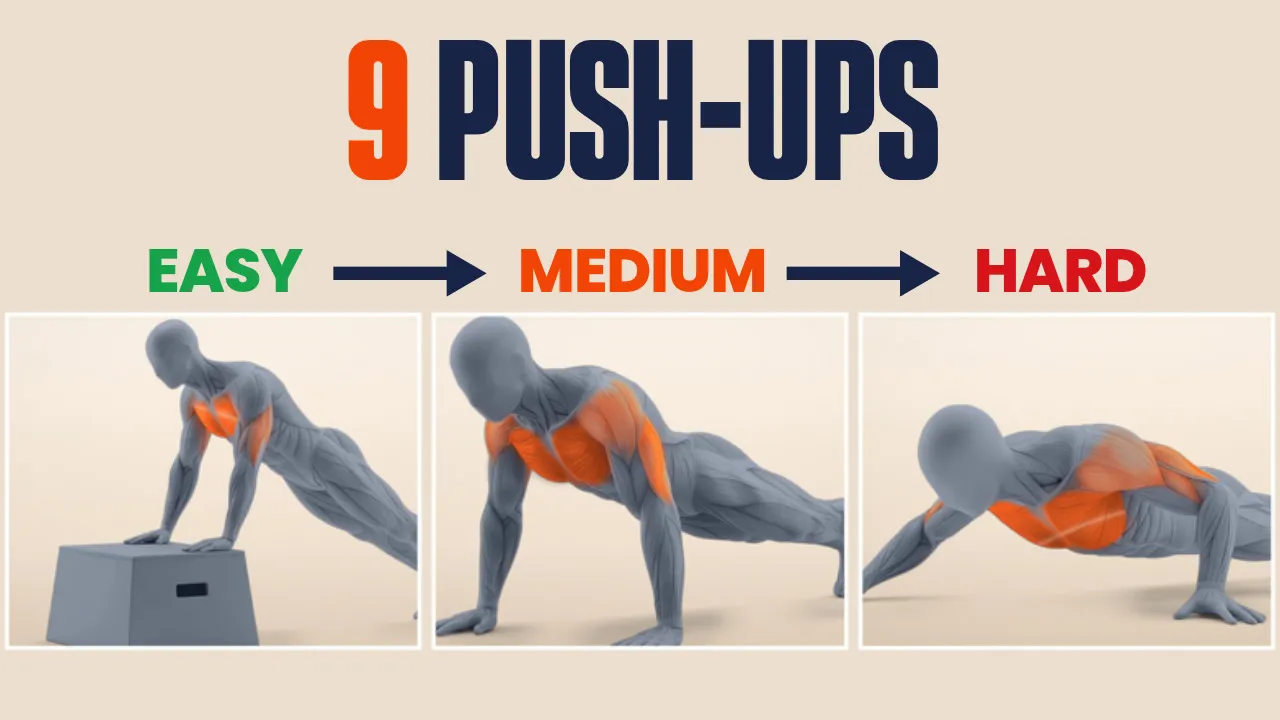
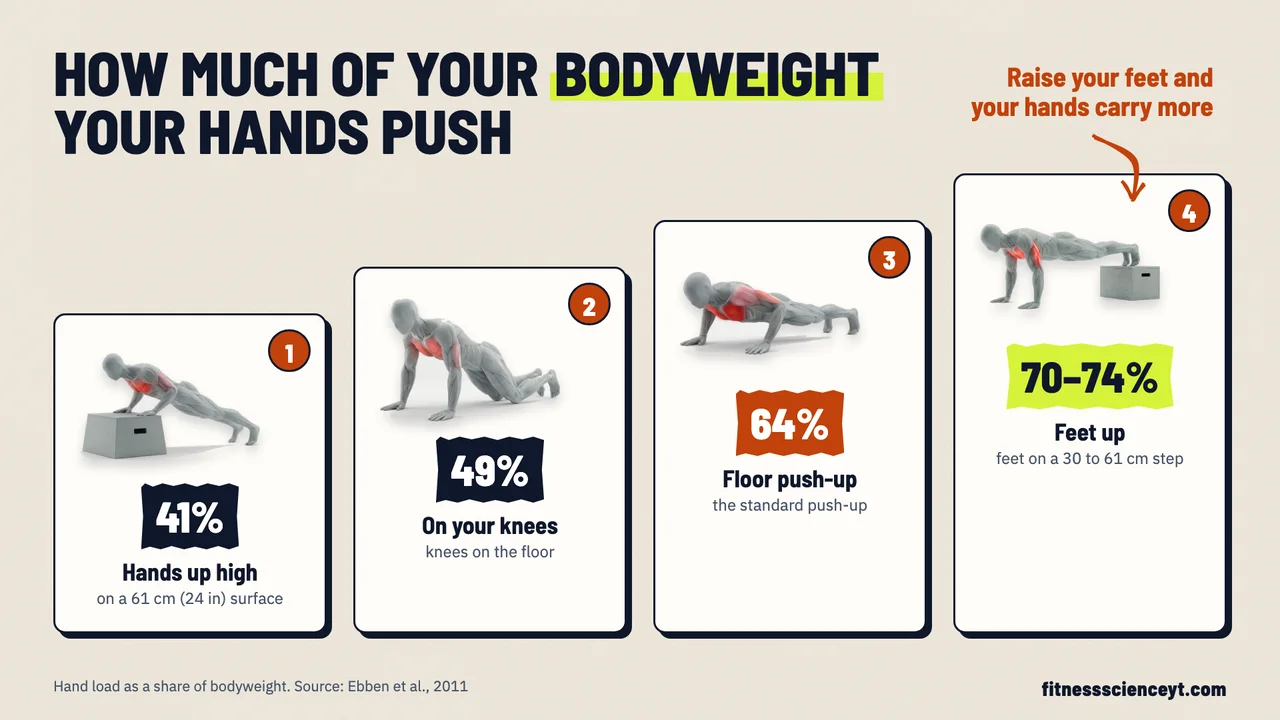
The trick for beginners is body angle. The higher your hands, the less of your weight you push. A force-plate study found that your hands carry about 41% of your bodyweight with hands on a 61 cm (24 in) surface, 49% on your knees, 55% on a 30 cm (12 in) step and 64% on the floor (Ebben and colleagues, 2011). That gives you a ladder from easy to hard with nothing but furniture.
And push-ups really do build muscle. In an 8-week study, young men who did push-ups twice a week, adjusted to their strength, gained about as much chest muscle and strength as a group doing a light bench press (Kikuchi and Nakazato, 2017). Another study found that progressive push-ups raised bench press strength in just 4 weeks (Kotarsky and colleagues, 2018).
5-minute warm-up
- Arm circles: 30 seconds each way.
- Wall slides: 10 slow reps with your back and arms against a wall.
- Doorway chest stretch: 30 seconds, gently.
- Wrist rocks: 30 seconds on your hands and knees.
- Practice set: 6 to 8 easy reps one step easier than your working level.
The beginner push-up ladder
Test yourself first: do as many push-ups as you can with your hands on a kitchen counter, 61 to 91 cm (24 to 36 in) high. Fewer than 8 reps, start at step 1. Between 8 and 15, start at step 2. More than 15, start at step 3 or 4.
1. Wall push-up
Trains: chest, shoulders and triceps at the lightest load.
How to do it: Stand about an arm's length from a wall, 60 to 90 cm (2 to 3 ft) away. Put your hands on the wall at chest height, elbows angled about 30 to 45 degrees from your body. Lower your chest toward the wall over 2 to 3 seconds, then press back.
Why it works: The load is low enough to learn the movement and the body position before adding weight.
Common mistake: sticking your hips back or shrugging your shoulders up to your ears.
Easier or harder: step closer to the wall to make it easier. Move on when you can do 3 sets of 15.
2. High incline push-up
Trains: chest, triceps and core, at about 41% of your bodyweight on a 61 cm (24 in) surface (Ebben and colleagues, 2011).
How to do it: Put your hands on a kitchen counter or sturdy table, a little wider than your shoulders. Brace your stomach so your body is straight. Lower over 2 to 3 seconds until your chest touches the edge, then press up.
Why it works: You get full range of motion with a light load. A review found that training through a full range of motion tends to build more muscle than partial reps (Wolf and colleagues, 2023).
Common mistake: doing half reps or flaring your elbows out to 90 degrees.
Easier or harder: use a higher surface to make it easier. Move on at 3 sets of 12 to 15.
3. Knee push-up or low incline push-up
On your knees, your hands carry about 49% of your bodyweight. With your hands on a 30 cm (12 in) step, it is about 55% (Ebben and colleagues, 2011). Both are good next steps. The low incline keeps you in a full plank, which may make the jump to floor push-ups easier, but either one works.
How to do it: Either put your hands on a sturdy chair or step about 30 cm (12 in) high with your legs straight, or kneel on a cushion with your hips pushed forward so your body is straight from knees to head. Keep your elbows at 30 to 45 degrees and lower until your chest nearly touches.
Common mistake: on knee push-ups, sitting your hips back toward your heels.
4. Standard floor push-up
Trains: the whole chest, front delts, triceps and core, at about 64% of your bodyweight (Ebben and colleagues, 2011).
How to do it: Place your hands a little wider than your shoulders. Brace so your body is a straight line. Lower over 2 to 3 seconds until your chest is about 2.5 cm (1 in) above the floor, elbows at 30 to 45 degrees, then press up.
Why it works: It gives your chest the most stretch and the most load of any beginner variation.
Common mistake: letting your hips sag or bouncing at the bottom.
Easier or harder: lower to a rolled towel to make depth easier to judge. Once you can do 3 sets of 12 to 15, add a 1-second pause at the bottom.
5. What comes next
- Wide push-up: hands about one and a half times shoulder width. See wide vs close-grip push-ups for when it helps.
- Low decline push-up: feet on a 30 cm (12 in) step, which raises the load to about 70% of your bodyweight (Ebben and colleagues, 2011). See our decline push-up guide.
- Palm press: press your palms together hard in front of your chest for 15 to 20 seconds. It is a simple way to feel your chest working.
| Step | Approx. load (% of bodyweight) | Focus | Move on at |
|---|---|---|---|
| 1. Wall | under 41% (estimate) | Elbows at 30 to 45 degrees | 3 x 15 |
| 2. Counter, 61 cm (24 in) | 41% | Chest touches the edge | 3 x 12 to 15 |
| 3. Knees | 49% | Straight line from knees to head | 3 x 12 to 15 |
| 3. Step, 30 cm (12 in) | 55% | Full plank | 3 x 12 |
| 4. Floor | 64% | Chest close to the floor | 3 x 12 to 15 |
Loads are from Ebben and colleagues (2011). The wall figure is our estimate, since the study did not test it.
The beginner workout
This takes 15 to 20 minutes:
- Main exercise, at your current step: 2 to 3 sets of 8 to 15 reps, lowering over 2 seconds, stopping with one or two reps left.
- Second exercise, one step easier: 1 to 2 sets of 10 to 15 reps.
- Optional finisher: 2 palm presses of 20 seconds.
Rest 90 to 120 seconds between sets. A review of rest periods found that longer rests tended to give slightly better muscle growth than very short ones, although the difference was small (Singer and colleagues, 2024). Keep every rep full depth (Wolf and colleagues, 2023). For how volume adds up as you get stronger, see how many push-ups it takes to build your chest.
How often to train, and a 4-week plan
Train 2 to 3 days a week with a day off in between. A review of training frequency found that training a muscle at least twice a week gave better growth than once a week (Schoenfeld, Ogborn and Krieger, 2016). More weekly sets also lead to more growth (Schoenfeld, Ogborn and Krieger, 2017), so the plan adds sets each week.
| Week | Days | Main / second exercise | Total sets |
|---|---|---|---|
| 1 | 2 (Mon, Thu) | 2 x 8 to 12 / 1 x 10 to 12 | 6, with 2 to 3 reps left |
| 2 | 2 (Mon, Thu) | 3 x 8 to 12 / 1 x 10 to 15 | 8, with 1 to 2 reps left |
| 3 | 3 (Mon, Wed, Fri) | 3 x 10 to 15 / 1 x 10 to 15 | 12, hard |
| 4 | 3 (Mon, Wed, Fri) | 3 x 8 to 12 at the next step / 1 x 10 to 12 | 12, then re-test |
Expect to move up the ladder within 4 weeks as you get stronger (Kotarsky and colleagues, 2018). Visible muscle growth takes longer, usually 8 weeks or more (Kikuchi and Nakazato, 2017). Add some rows twice a week, for example pulling a towel looped around a sturdy door handle, to balance all the pushing.
Common beginner mistakes
- Feeling it only in your arms or shoulders. Hands too close together load the triceps, and flared elbows and half reps load the front shoulders. Go up a step, place your hands a little wider than your shoulders, keep your elbows at 30 to 45 degrees and lower all the way.
- Sagging hips. Squeeze your stomach and glutes. If your back still arches, raise your hands.
- Short reps. Your hands carry the most load near the bottom of a push-up (Suprak and colleagues, 2011). Touch a target every rep.
- Sore wrists. Use a higher surface, a folded towel under your palms, or push up on your fists.
- Training every day with short rests. Give your chest a day off between sessions and rest 90 to 120 seconds between sets.
How to progress without weights
- Lower your hands or raise your feet: going from a 61 cm (24 in) incline to feet raised 61 cm adds about a third of your bodyweight to your hands (Ebben and colleagues, 2011).
- Add reps: reach 15 clean reps before moving down a step.
- Slow down: lower over 3 seconds or pause for 1 to 2 seconds at the bottom.
- Change leverage, keep your rest: use wide or feet-raised push-ups to make it harder, rather than cutting rest below 60 seconds.
Key takeaways
- Changing hand height gives you a ladder from about 41% to 74% of your bodyweight with no equipment.
- Full-depth reps with elbows at 30 to 45 degrees work the chest and protect the shoulders.
- Train 2 to 3 non-consecutive days a week, building from 6 to 12 sets with 90 to 120 seconds of rest.
- Expect strength gains in about 4 weeks and visible chest growth over 8 weeks or more.
Frequently asked questions
Can you build chest muscle at home without equipment?
Yes. In an 8-week study, push-ups adjusted to each person's strength built about as much chest muscle as a light bench press (Kikuchi and Nakazato, 2017).
Why do I feel push-ups in my arms or shoulders instead of my chest?
Hands too close together shift work to the triceps, while flared elbows and half reps shift it to the shoulders. Move up a step, keep your elbows at 30 to 45 degrees and use full depth.
Are knee push-ups or incline push-ups better for beginners?
Both work. A 30 cm (12 in) incline is a little heavier, about 55% of your bodyweight vs 49% on your knees, and keeps you in a full plank. Pick the one where you can do 8 to 15 good reps.
How long does it take to see results?
Strength improves within about 4 weeks (Kotarsky and colleagues, 2018). Visible chest growth usually takes 8 weeks or more (Kikuchi and Nakazato, 2017).
Safety note
This guide is general fitness information, not medical advice. If you have a shoulder, wrist, elbow or back injury, or you feel sharp pain, stop and check with a doctor or physiotherapist.
Sources
- Ebben WP, Wurm B, VanderZanden TL, et al. Kinetic analysis of several variations of push-ups. Journal of Strength and Conditioning Research. 2011;25(10):2891-2894. doi:10.1519/JSC.0b013e31820c8587
- Suprak DN, Dawes J, Stephenson MD. The effect of position on the percentage of body mass supported during traditional and modified push-up variants. Journal of Strength and Conditioning Research. 2011;25(2):497-503. doi:10.1519/JSC.0b013e3181bde2cf
- Kikuchi N, Nakazato K. Low-load bench press and push-up induce similar muscle hypertrophy and strength gain. Journal of Exercise Science & Fitness. 2017;15(1):37-42. doi:10.1016/j.jesf.2017.06.003
- Kotarsky CJ, Christensen BK, Miller JS, Hackney KJ. Effect of progressive calisthenic push-up training on muscle strength and thickness. Journal of Strength and Conditioning Research. 2018;32(3):651-659. doi:10.1519/JSC.0000000000002345
- Schoenfeld BJ, Ogborn D, Krieger JW. Effects of resistance training frequency on measures of muscle hypertrophy: a systematic review and meta-analysis. Sports Medicine. 2016;46(11):1689-1697. doi:10.1007/s40279-016-0543-8
- Schoenfeld BJ, Ogborn D, Krieger JW. Dose-response relationship between weekly resistance training volume and increases in muscle mass: a systematic review and meta-analysis. Journal of Sports Sciences. 2017;35(11):1073-1082. doi:10.1080/02640414.2016.1210197
- Wolf M, Androulakis-Korakakis P, Fisher J, Schoenfeld B, Steele J. Partial vs full range of motion resistance training: a systematic review and meta-analysis. International Journal of Strength and Conditioning. 2023;3(1). doi:10.47206/ijsc.v3i1.182
- Singer A, Wolf M, Generoso L, et al. Give it a rest: a systematic review with Bayesian meta-analysis on the effect of inter-set rest interval duration on muscle hypertrophy. Frontiers in Sports and Active Living. 2024;6:1429789. doi:10.3389/fspor.2024.1429789
Related guides