Home / Chest / How Many Push-Ups to Build Chest Muscle?
How Many Push-Ups to Build Chest Muscle?
By Fitness ScienceUpdated 8 min read8 peer-reviewed studiesEditorial policy
- No equipment
- All levels
- 3-day plan
On this page
"How many push-ups a day?" is the wrong question for building muscle. Your chest grows from enough hard sets each week, not from a daily total. This guide shows what the research says, how to set your own target and how to keep progressing. You can plug the numbers straight into our full no-equipment chest workout.
What the research shows
Push-ups can build as much muscle as the bench press. In an 8-week study, 18 young men trained twice a week with either push-ups or a bench press at 40% of their one-rep max. The push-ups were adjusted, for example done on the knees, to match the bench press load. Both groups gained similar chest and triceps thickness and similar strength (Kikuchi and Nakazato, 2017).
Light loads work if you push hard. A review of 21 studies found that light and heavy loads build about the same muscle when sets are taken to failure. Heavy loads were better for building maximum strength (Schoenfeld and colleagues, 2017).
Effort matters. A 2024 analysis found that muscle growth tended to be greater the closer sets were taken to failure (Robinson and colleagues, 2024). Easy sets far from failure do much less.
Growth takes longer than strength. In a 4-week study of 23 men, both push-up and bench press training increased strength, but neither produced a measurable change in muscle thickness yet (Kotarsky and colleagues, 2018). Over 8 weeks, muscle growth was clear (Kikuchi and Nakazato, 2017).
Sets, reps and weekly volume
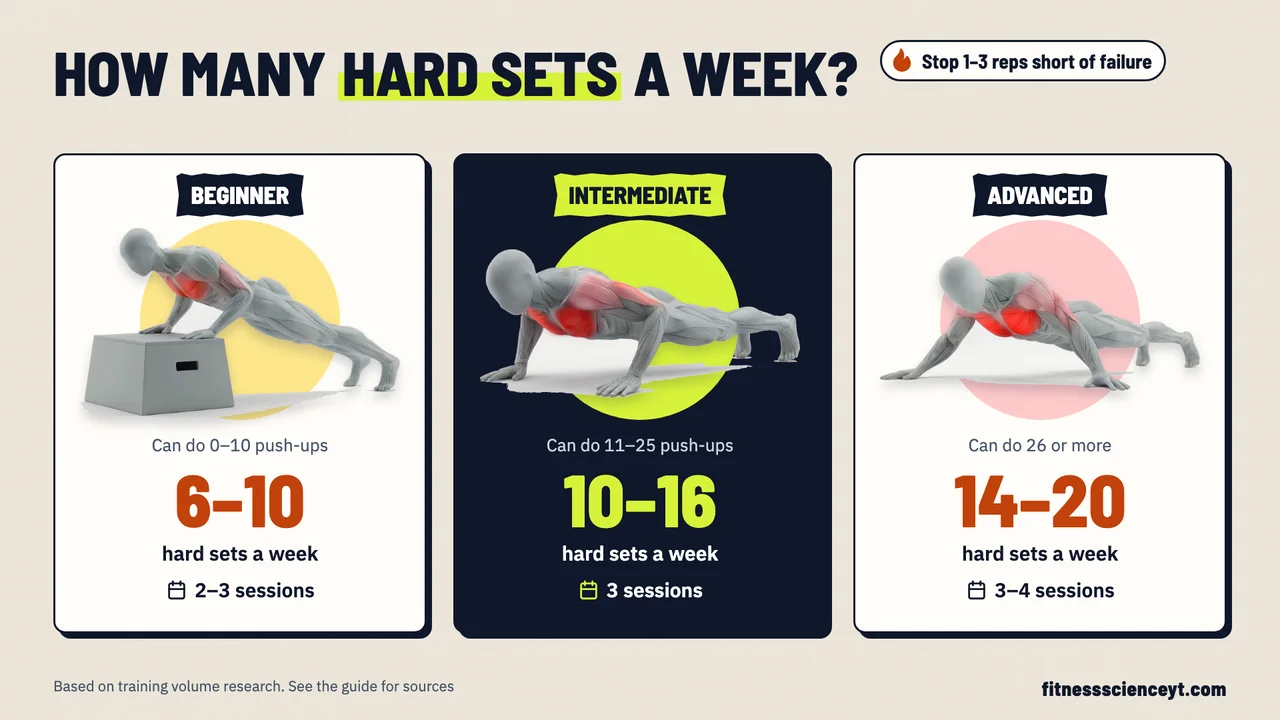
More weekly sets lead to more growth, up to a point. A review of 15 studies found a clear dose response: each extra weekly set added a little more growth, and higher volumes beat lower ones (Schoenfeld, Ogborn and Krieger, 2017). For most people, 10 to 20 hard sets a week for the chest is a good target. If you are a beginner who cannot do 8 floor push-ups yet, start with our beginner chest workout at home.
| Level | Max strict push-ups | Hard sets per week | Sessions per week | Per session |
|---|---|---|---|---|
| Beginner | 0 to 10 | 6 to 10 | 2 to 3 | 3 sets of 6 to 15 incline push-ups |
| Intermediate | 11 to 25 | 10 to 16 | 3 | 3 to 5 sets of 8 to 20, floor or feet raised |
| Advanced | 26 or more | 14 to 20 | 3 to 4 | 4 to 5 sets of 8 to 18, weighted or archer |
How to find your number
- Test one strict max set. Lower over 2 seconds until your chest touches the floor, keep your body rigid, and stop when your hips sag or your form breaks.
- Pick a version you can do 8 to 25 times. Under 8 reps, make it easier with an incline. Over 25, make it harder.
- Stop each set one to three reps short of failure. Your first set will usually be about three quarters of your max. Rest 90 seconds to 3 minutes between sets.
Daily push-ups or 2 to 4 days a week?
How often you train matters less than how many hard sets you do in total. A review of 25 studies found no real difference in muscle growth between training frequencies when the weekly sets were the same (Schoenfeld, Grgic and Krieger, 2019).
Daily rep targets also tend to be easy sets. If your max is 50 push-ups, a set of 20 leaves you about 30 reps from failure, and that does little for growth. Doing every set to failure every day is the opposite problem: your joints will complain. A better plan is 10 to 20 hard sets spread over 2 to 4 non-consecutive days.
How to keep progressing
Once you can do more than about 25 strict floor push-ups, more reps mostly train endurance. Make each rep harder instead.
Raising your feet adds load. Hand load rises from about 64% of your bodyweight on the floor to 70 to 74% with your feet raised 30 to 61 cm (12 to 24 in) (Ebben and colleagues, 2011). Elastic bands work too. In a 5-week study, push-ups with bands set to a 6-rep max increased strength about as much as a bench press with the same effort (Calatayud and colleagues, 2015).
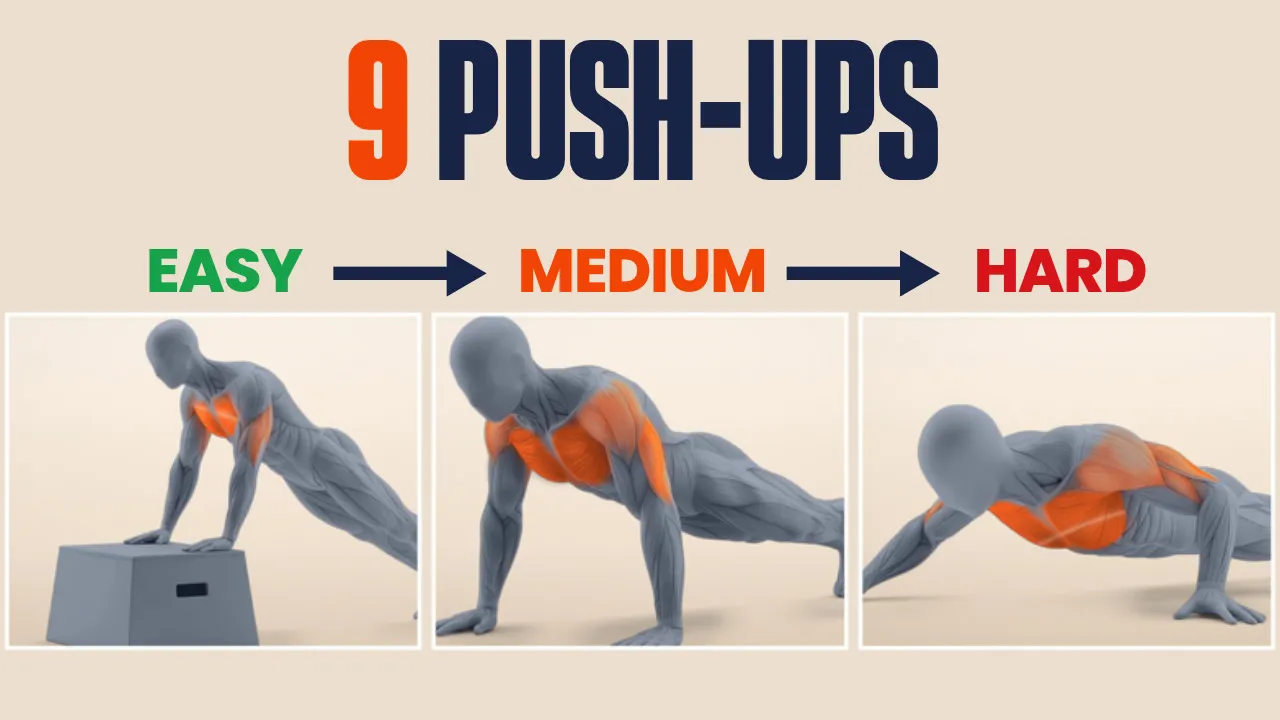
- Easier, if you get fewer than 8 reps: push-ups against a wall, with hands on a 61 cm (24 in) surface, on your knees, or with hands on a 30 cm (12 in) step.
- Standard floor push-up: the staple for 8 to 25 strict reps.
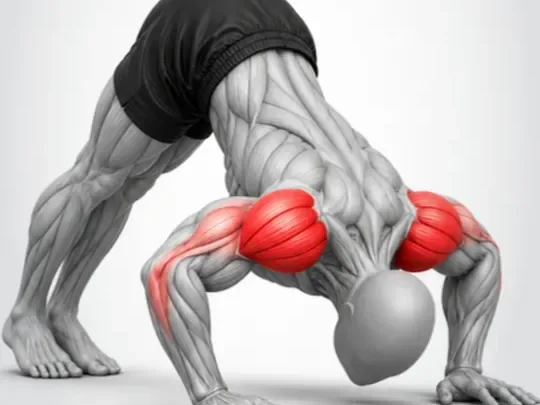
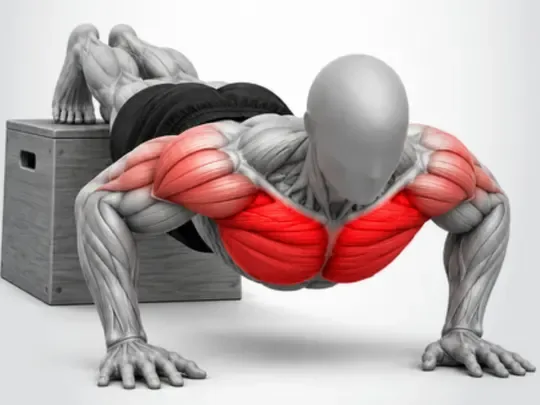
- Harder, once you pass 25 to 30 reps: put your hands on blocks for extra depth, or raise your feet as in our decline push-up guide.
- Hardest: slow the lowering to 3 to 4 seconds with a pause at the bottom, add a band or a backpack with 2.5 to 5 kg (5 to 11 lb), or move to archer push-ups.
Form for muscle growth
Clean form keeps the tension on your chest. Hand width changes which muscles work hardest, which we cover in wide vs close-grip push-ups.
The standard push-up for muscle
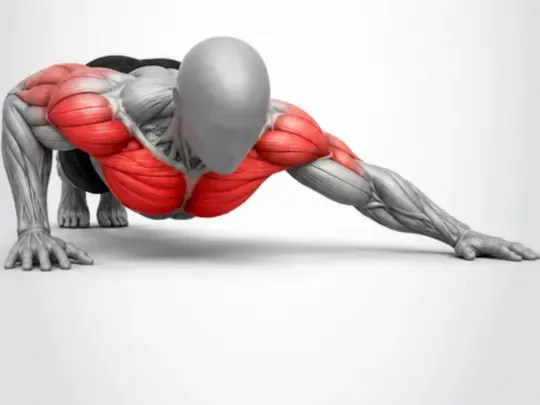
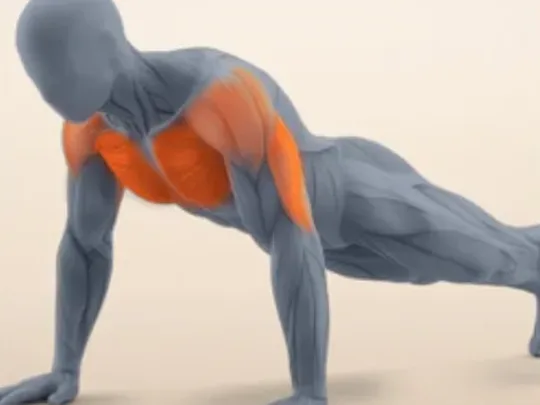
Trains: chest, front delts, triceps and serratus anterior.
How to do it: Place your hands a little wider than your shoulders. Brace so your body is a straight line. Lower over 2 to 3 seconds with your elbows about 30 to 45 degrees from your body, until your chest touches the floor. Pause for half a second, then press up in about 1 second.
Why it works: Lowering slowly and pausing at the bottom keeps the chest under tension at its longest point, where it cannot use the bounce of the stretch to help.
Common mistake: stopping 10 to 15 cm (4 to 6 in) above the floor, or flaring your elbows out to 90 degrees. Short reps cut the stretch and flared elbows irritate the shoulders.
Easier or harder: put your hands on a box 30 to 61 cm (12 to 24 in) high to make it easier. Use blocks for extra depth, raise your feet or add a band to make it harder.
Other errors
- Bouncing. Fast reps use the stretch reflex instead of your muscles. Control the bottom.
- Never pulling. Lots of pushing without any rows can round your shoulders forward. Add rows to every week.
A sample 3-day plan
This Monday, Wednesday and Friday plan gives you about 13 to 14 hard chest sets a week, plus pulling work.
| Day | Push-ups | Pulling | Effort and rest |
|---|---|---|---|
| Monday | 4 x 10 to 20 floor or deficit push-ups | 3 x 10 to 15 inverted rows | 1 to 2 reps left, 2 min |
| Wednesday | 4 x 8 to 15 feet-raised push-ups, plus 1 to 2 slow sets | Shoulder blade warm-up | 1 to 2 reps left, 2 min |
| Friday | 4 x 8 to 15 banded, weighted or deficit push-ups | 3 x 10 to 15 rows with a backpack or dumbbell | 0 to 2 reps left, 2 to 3 min |
When every set reaches the top of its rep range with one or two reps left, move to a harder version or add 2.5 to 5 kg (5 to 11 lb). Eating enough protein supports the growth.
Key takeaways
- Aim for 10 to 20 hard sets a week, or 6 to 10 if you are a beginner, spread over 2 to 4 non-consecutive days.
- Stop each set one to three reps before failure and rest 90 seconds to 3 minutes.
- Expect strength gains in a few weeks and visible muscle growth over 8 weeks or more.
- Once you pass about 25 floor push-ups, make each rep harder with deficits, raised feet, bands, weight or archer push-ups.
Frequently asked questions
Will 50 push-ups a day build chest muscle?
For a beginner, yes, if those 50 come in 3 or 4 hard sets. Once you can do more than about 25 in a row, 10 to 16 weekly sets of a harder variation will build more.
What happens if you do 100 push-ups a day?
You will build endurance. For muscle growth, it is not better than the same number of hard sets spread over 2 to 4 days (Schoenfeld, Grgic and Krieger, 2019), and it raises the risk of wrist and shoulder overuse.
How long until I see chest growth from push-ups?
Strength improves within a few weeks. One 4-week study found no change in muscle thickness yet (Kotarsky and colleagues, 2018), while an 8-week study found clear growth (Kikuchi and Nakazato, 2017).
Why do I feel push-ups in my arms more than my chest?
Usually because your hands are close together, your elbows are tucked tight to your ribs or you stop short of the floor. Place your hands a little wider than your shoulders, keep your elbows at 30 to 45 degrees and lower all the way down.
Safety note
This guide is general fitness information, not medical advice. Warm up your wrists and shoulders with a few easy incline push-ups before hard sets, and stop if you feel sharp shoulder, elbow or wrist pain. Balance your pushing with rows, and check with a doctor or physiotherapist before high-volume training if you have an injury.
Sources
- Kikuchi N, Nakazato K. Low-load bench press and push-up induce similar muscle hypertrophy and strength gain. Journal of Exercise Science & Fitness. 2017;15(1):37-42. doi:10.1016/j.jesf.2017.06.003
- Kotarsky CJ, Christensen BK, Miller JS, Hackney KJ. Effect of progressive calisthenic push-up training on muscle strength and thickness. Journal of Strength and Conditioning Research. 2018;32(3):651-659. doi:10.1519/JSC.0000000000002345
- Calatayud J, Borreani S, Colado JC, et al. Bench press and push-up at comparable levels of muscle activity results in similar strength gains. Journal of Strength and Conditioning Research. 2015;29(1):246-253. doi:10.1519/JSC.0000000000000589
- Schoenfeld BJ, Ogborn D, Krieger JW. Dose-response relationship between weekly resistance training volume and increases in muscle mass: a systematic review and meta-analysis. Journal of Sports Sciences. 2017;35(11):1073-1082. doi:10.1080/02640414.2016.1210197
- Schoenfeld BJ, Grgic J, Ogborn D, Krieger JW. Strength and hypertrophy adaptations between low- vs. high-load resistance training: a systematic review and meta-analysis. Journal of Strength and Conditioning Research. 2017;31(12):3508-3523. doi:10.1519/JSC.0000000000002200
- Robinson ZP, Pelland JC, Remmert JF, et al. Exploring the dose-response relationship between estimated resistance training proximity to failure, strength gain, and muscle hypertrophy: a series of meta-regressions. Sports Medicine. 2024;54(9):2209-2231. doi:10.1007/s40279-024-02069-2
- Schoenfeld BJ, Grgic J, Krieger J. How many times per week should a muscle be trained to maximize muscle hypertrophy? A systematic review and meta-analysis. Journal of Sports Sciences. 2019;37(11):1286-1295. doi:10.1080/02640414.2018.1555906
- Ebben WP, Wurm B, VanderZanden TL, et al. Kinetic analysis of several variations of push-ups. Journal of Strength and Conditioning Research. 2011;25(10):2891-2894. doi:10.1519/JSC.0b013e31820c8587
Related guides