Pike Push-Up: Form, Muscles Worked and Progressions
By Fitness ScienceUpdated 8 min read7 peer-reviewed studiesEditorial policy
- No equipment
- All levels
- Shoulders
On this page
Most home push workouts are horizontal presses, like the push-ups in our full no-equipment chest workout. The pike push-up adds the missing vertical press, so your shoulders get direct work without a barbell or dumbbells. This guide covers what it trains, how to do it well, the usual mistakes and how to build up to a handstand push-up.
What is a pike push-up?
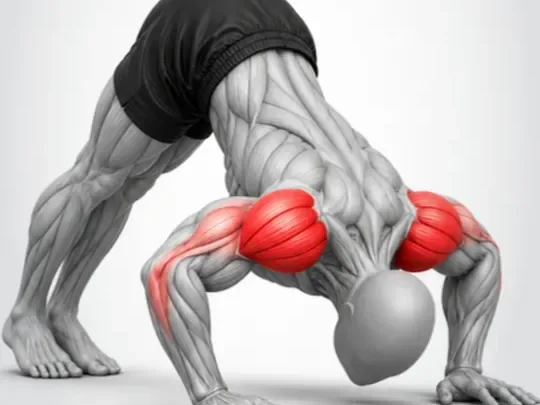
You start in a push-up position, then walk your feet in and lift your hips until your body makes an upside-down V. From there you bend your elbows and lower the top of your head toward the floor, then press back up.
Folding at the hips changes the direction you press. In a normal push-up you push away from the floor in front of your chest. In a pike you push up over your head, much like an overhead press. That is why it feels harder on the shoulders and easier on the chest than a decline push-up for the upper chest, where your body stays straight.
Muscles worked
No study has measured muscle activity in the floor pike push-up directly. What we know comes from research on pressing at different angles, which shows a clear pattern: the more upright the press, the more the shoulders take over.
- Front delts: in a study of 30 trained adults, front-delt activity was highest at the steepest bench angle tested (60 degrees), and angles above 45 degrees shifted work away from the chest and onto the shoulders (Rodríguez-Ridao and colleagues, 2020).
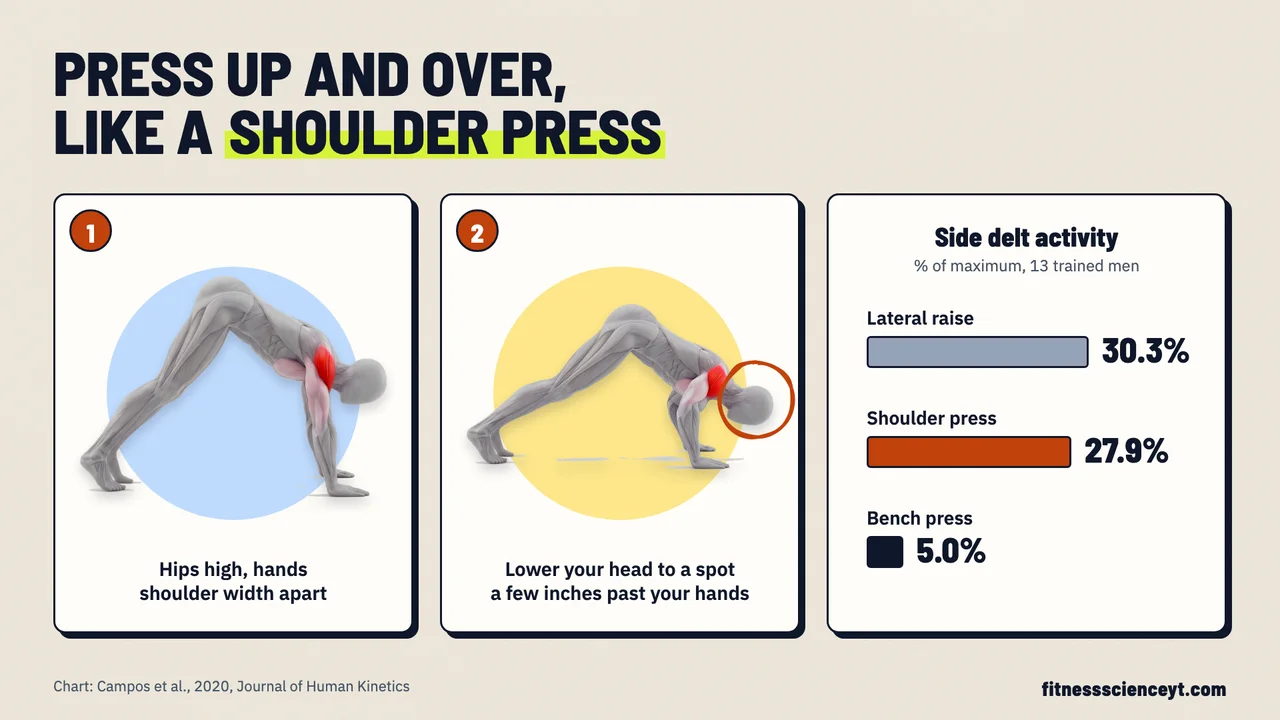
- Side delts: an overhead press worked the side delt almost as much as a lateral raise (27.9% vs 30.3% of maximum), while a bench press barely used it (5%) (Campos and colleagues, 2020).
- Triceps: they straighten your elbows on every rep. Triceps activity stayed similar across all bench angles in the same study (Rodríguez-Ridao and colleagues, 2020).
- Serratus anterior: this muscle on the side of your ribs rotates your shoulder blades upward as you lock out. In a push-up plus study, raising the legs to a steeper angle raised serratus activity without adding upper-trap activity (Lee and Kim, 2019).
- Upper chest: it helps, but less than in flatter presses. Upper-chest activity peaked at a 30 degree angle (Rodríguez-Ridao and colleagues, 2020).
How to do a pike push-up
Trains: front and side delts, triceps, serratus anterior and the upper trapezius, with some upper chest.
How to do it: Put your hands on the floor about shoulder width apart. Walk your feet in and lift your hips until your body is an upside-down V. Look back toward your feet. Bend your elbows and lower slowly, over about 2 seconds, so the top of your head lands a few inches in front of your hands. Your head, hands and the floor should make a triangle. Press back up until your arms are fully straight and your ears are between your arms.
Why it works: The triangle position keeps your forearms close to vertical, so your shoulders and triceps press in a straight line. A full lockout at the top makes your shoulder blades rotate, which trains the serratus anterior.
Common mistake: lowering your head straight down between your hands. This shifts your weight back, flares the elbows and makes the rep a lot easier without you noticing.
Easier or harder: put your hands on a bench or step to make it easier. Put your feet on a box or use parallettes to make it harder.
Hand width and elbow angle
Keep your hands about shoulder width apart. In standard push-ups, narrower hands produced more chest and triceps activity than wide hands (Cogley and colleagues, 2005), and the same idea applies here: very wide hands make the press weaker.
Angle your elbows back at roughly 30 to 45 degrees from your body. In a study of the standard push-up, flaring the elbows reduced the shoulder-blade tilt and rotation that keep the joint comfortable (Suprak and colleagues, 2013).
Common mistakes and fixes
- Head between the hands. Put a piece of tape a few inches in front of your fingertips and aim for it.
- Elbows flared to 90 degrees. Turn your hands slightly outward and keep the elbows pointing back.
- Hips dropping. If your hips sink, the move turns into a regular push-up. Keep them high and stack them over your shoulders.
- Stopping short at the top. Straighten your arms completely and push the floor away.
- Rounded back. If tight hamstrings pull your back round, bend your knees slightly.
- Bouncing your head. Control the bottom of each rep. Never put weight on your neck.
Regressions and progressions
Body angle changes how much weight your hands carry. A force-plate study of push-ups found hand load ranged from about 41% of bodyweight with hands raised 61 cm (24 in) to 74% with feet raised 61 cm (Ebben and colleagues, 2011). Pikes follow the same rule: hands up is easier, feet up is harder.
| Stage | Variation | Move on when you can do |
|---|---|---|
| Easier | Hands on a bench, 30 to 60 cm (12 to 24 in) | 3 sets of 10 to 12 |
| Easier | Floor pike with bent knees | 3 sets of 8 to 10 |
| Standard | Floor pike push-up | 3 to 4 sets of 10 to 12 |
| Harder | Feet on a box, 30 to 60 cm (12 to 24 in) | 3 to 4 sets of 8 to 10 |
| Harder | Pike on parallettes or blocks, for extra depth | 3 to 4 sets of 6 to 10 |
| Hardest | Wall handstand push-up | Start with 30 to 45 second wall holds and slow negatives |
Once floor pikes feel solid, raise your feet in small steps. When you can do 8 to 10 clean reps with your feet on a box, start practising wall handstand holds and slow lowering reps. The archer push-up is a good partner move on the same day, since it trains the chest one side at a time.
Mobility and safety tips
- Sore wrists: use parallettes, push-up handles or hex dumbbells to keep your wrists straight, or put your hands on a bench.
- Tight hamstrings: bend your knees and stay on your toes.
- Head pressure: breathe out as you press, keep sets short and rest about 2 minutes. Start with hands raised.
- Pinching in the shoulder: raise your hands, keep the elbows angled back, and only work in a range that feels comfortable.
How to program pike push-ups
Push-ups can build muscle as well as a light bench press. In an 8-week study, push-ups twice a week grew the chest and triceps about as much as bench pressing at 40% of a one-rep max (Kikuchi and Nakazato, 2017). The same principle of hard sets close to failure applies to pikes.
| Level | Variation | Sets and reps | Rest | Days per week |
|---|---|---|---|---|
| Beginner | Hands raised or bent knees | 3 x 6 to 10 | 90 seconds | 2 |
| Intermediate | Floor or low box | 3 to 4 x 6 to 12 | 90 to 120 seconds | 2 to 3 |
| Advanced | High box, deficit or negatives | 3 to 5 x 4 to 8 | 2 to 3 minutes | 2 to 3 |
Do pikes early in your session while you are fresh. Stop each set with one or two good reps left. Balance all this pressing with rows or other pulling work for your upper back. For total push-up volume across the week, see how many push-ups it takes to build your chest.
Key takeaways
- The pike push-up turns a push-up into a vertical press, so it trains your shoulders far more than a standard push-up.
- Lower your head to a spot a few inches in front of your hands, keep your elbows angled back, and lock out fully.
- Bend your knees if tight hamstrings round your back.
- Progress from hands raised to the floor, then feet on a box, parallettes and finally wall handstand push-ups.
Frequently asked questions
Can pike push-ups replace the overhead press?
For home training, yes, up to a point. They load the shoulders in a similar direction, and an overhead press works the front and side delts much more than a bench press (Campos and colleagues, 2020). Once feet-raised pikes get easy, move toward handstand push-ups or add weight.
Do pike push-ups work the side delts?
Yes. Overhead pressing worked the side delt almost as much as a lateral raise in one study (Campos and colleagues, 2020). Pikes press in a similar direction.
Where should my head go?
A few inches in front of your hands, so your head and hands form a triangle. This keeps your forearms vertical and the press strong.
How many pike push-ups before trying wall handstand push-ups?
Aim for 3 to 4 sets of 8 to 10 clean reps with your feet on a box about 60 cm (24 in) high, plus a 30 to 45 second wall handstand hold.
Safety note
This guide is general fitness information, not medical advice. Stop if you feel sharp shoulder, neck or wrist pain, or if you feel dizzy. If you have a shoulder injury, a neck problem or high blood pressure, check with a doctor or physiotherapist before training upside down.
Sources
- Ebben WP, Wurm B, VanderZanden TL, et al. Kinetic analysis of several variations of push-ups. Journal of Strength and Conditioning Research. 2011;25(10):2891-2894. doi:10.1519/JSC.0b013e31820c8587
- Rodríguez-Ridao D, Antequera-Vique JA, Martín-Fuentes I, Muyor JM. Effect of five bench inclinations on the electromyographic activity of the pectoralis major, anterior deltoid, and triceps brachii during the bench press exercise. International Journal of Environmental Research and Public Health. 2020;17(19):7339. doi:10.3390/ijerph17197339
- Campos YAC, Vianna JM, Guimarães MP, et al. Different shoulder exercises affect the activation of deltoid portions in resistance-trained individuals. Journal of Human Kinetics. 2020;75:5-14. doi:10.2478/hukin-2020-0033
- Lee S, Kim J. The effect of leg angle during push-up plus exercise on shoulder stabilization muscle activity. Journal of Physical Therapy Science. 2019;31(1):33-35. doi:10.1589/jpts.31.33
- Suprak DN, Bohannon J, Morales G, et al. Scapular kinematics and shoulder elevation in a traditional push-up. Journal of Athletic Training. 2013;48(6):826-835. doi:10.4085/1062-6050-48.5.08
- Cogley RM, Archambault TA, Fibeger JF, et al. Comparison of muscle activation using various hand positions during the push-up exercise. Journal of Strength and Conditioning Research. 2005;19(3):628-633. doi:10.1519/15094.1
- Kikuchi N, Nakazato K. Low-load bench press and push-up induce similar muscle hypertrophy and strength gain. Journal of Exercise Science & Fitness. 2017;15(1):37-42. doi:10.1016/j.jesf.2017.06.003
Related guides